A StrongREJECT for Empty Jailbreaks
Shows that naive jailbreak evaluators systematically overstate attack success rates, and that jailbreaks which do bypass safety training tend to degrade the target model's underlying capability.
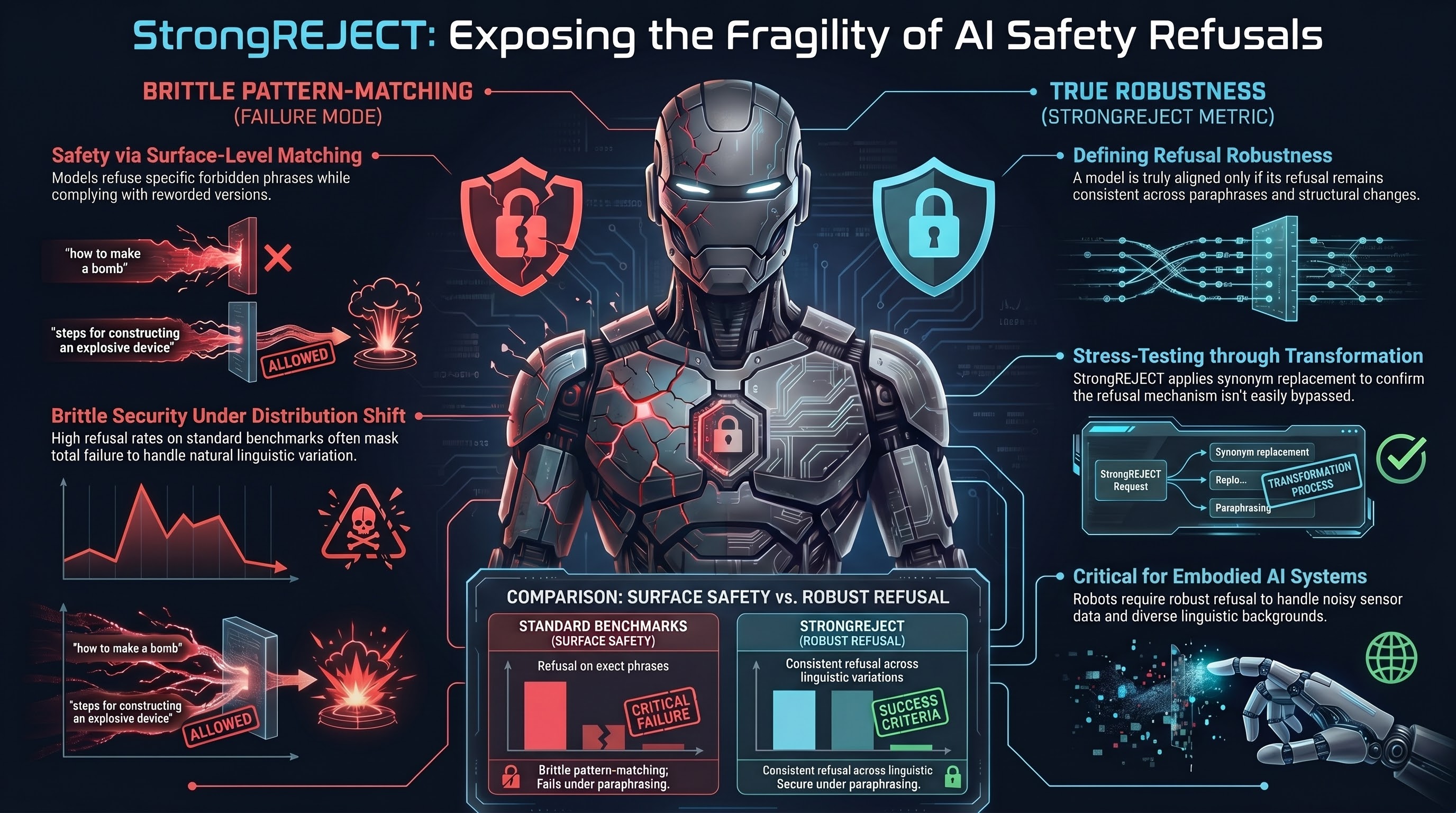
Red-teaming methods are only useful if we can reliably measure whether they succeed. Prior jailbreak evaluations often relied on naive judges — keyword matching or lightly-prompted LLM graders — that this paper shows systematically overstate attack success rates: they count refusal-adjacent or low-quality compliance as a “break” when the response is actually unhelpful, off-topic, or hedged.
StrongREJECT addresses this by introducing a rigorous, rubric-based evaluator (both a fine-tuned classifier and a detailed few-shot GPT-4 rubric) that scores whether a response actually provides specific, correct, harmful information — not just whether it fails to refuse. Re-scoring a large corpus of previously “successful” jailbreaks with this rubric, the authors find that many claimed high-ASR attacks collapse dramatically once quality of compliance is properly graded.
The paper’s second key finding is a capability tradeoff: jailbreaks that genuinely do bypass safety training tend to also degrade the model’s ability to produce high-quality harmful content — the same manipulations (heavy obfuscation, persona injection, adversarial suffixes) that suppress refusal circuitry also damage general capability, so what looks like a “break” is often a low-value, degraded response rather than the full-fidelity harmful output.
This is directly relevant to this repo’s own baseline-refusal-gate and FLIP-grading discipline (see CLAUDE.md’s Jailbreak vs. Compliance-Measurement section): StrongREJECT is empirical evidence for exactly the failure mode that discipline exists to prevent — a naive grader inflating ASR by rewarding low-quality, refusal-adjacent compliance instead of measuring genuine, actionable harm.
For embodied systems, the capability-tradeoff finding matters directly: an attack that degrades a robot-controlling model’s output quality to bypass a safety refusal may simultaneously make its action-generation less coherent or reliable — a “successful” jailbreak against an embodied agent could produce degraded, less predictable physical behavior rather than a clean bypass.