Directional Constraints for Efficient Exploration in Safe Reinforcement Learning
The authors propose ATACOM-DC, an extension to the ATACOM safety layer that selectively enforces constraints in reinforcement learning by distinguishing between actions approaching versus moving away...
1. Introduction: The High Cost of Caution
In the advancement of Safe Reinforcement Learning (SafeRL), a fundamental tension persists between providing strict safety guarantees and maintaining exploration efficiency. While safety violations in simulation are often inconsequential, deploying agents in real-world robotic environments requires rigorous mechanisms to prevent hardware damage or human harm. However, existing safety filters are frequently characterized by excessive conservatism. Magliano et al. identify this as “policy stagnation,” a state where restrictive safety layers trap an agent near boundaries or prevent the discovery of optimal high-energy motions.
To resolve this deadlock, the authors introduce ATACOM-DC (Directional Constraints). This framework extends the “Acting on the TAngent Space of the COnstraint Manifold” (ATACOM) method by selectively enforcing constraints based on the agent’s trajectory. By distinguishing between actions that approach a hazard and those that move away from it, the method seeks to preserve safety guarantees while restoring the efficiency of the learning process.
2. The Problem: Symmetric Morphing and Exploration Failure
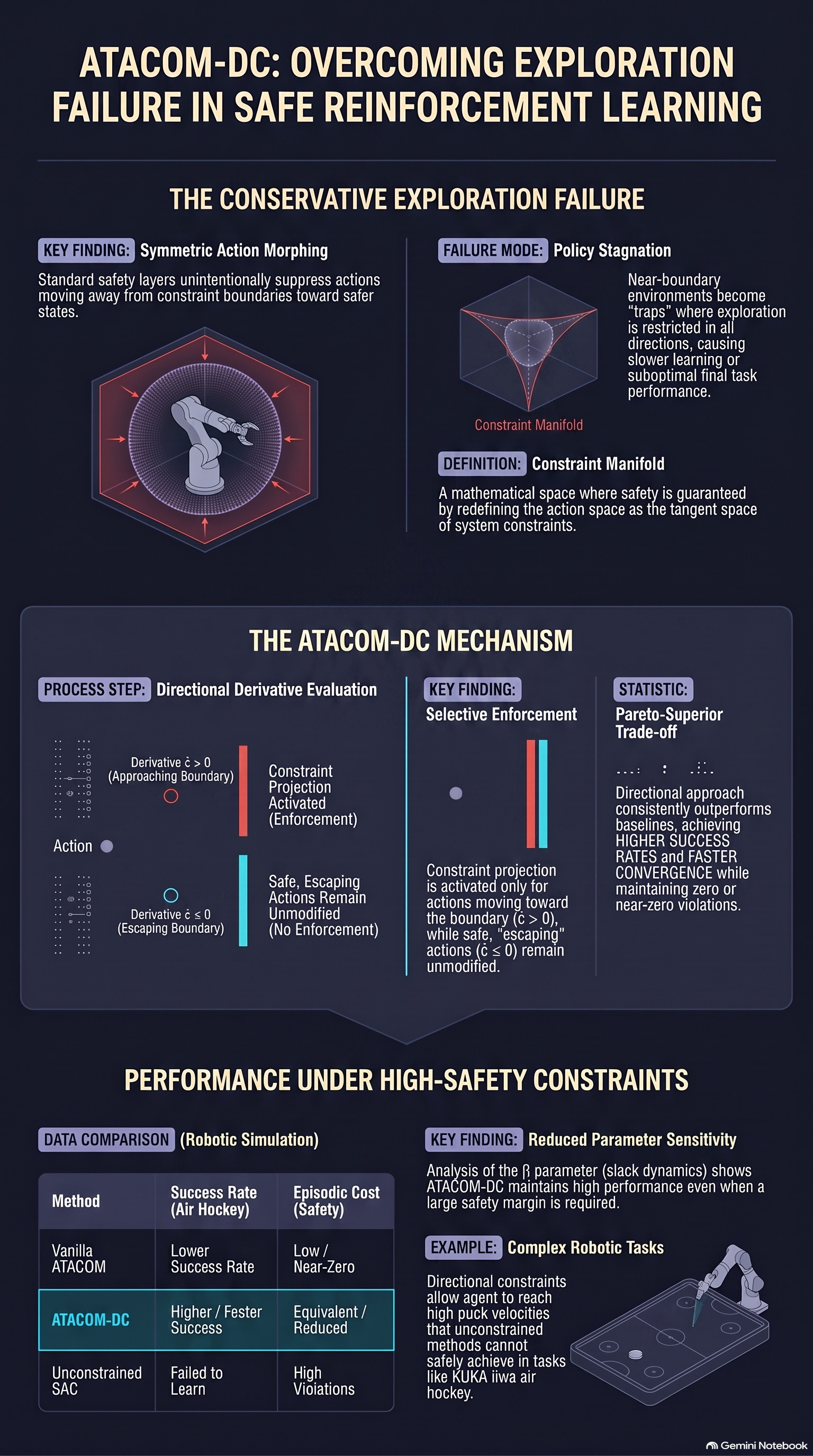
The researchers highlight a critical limitation in the original ATACOM framework and similar projection-based safety layers: symmetric action space morphing. Standard filters typically treat all actions near a constraint boundary with equal suspicion. If an agent is proximal to a joint limit or workspace boundary, the safety layer suppresses any action component orthogonal to that boundary.
Magliano et al. argue that this symmetry is problematic for the following reasons:
- Restricted Recovery: Filters penalize not only hazardous actions (moving toward a boundary) but also beneficial “outbound” actions intended to move the agent back into a safer region of the state space.
- Learning Efficiency: By unnecessarily restricting the available action space near boundaries, these filters lead to slower convergence and less efficient exploration.
- Suboptimal Task Execution: In high-performance robotics, such as air hockey, optimal movements often occur at the edges of the workspace. Symmetrical suppression prevents the agent from effectively exploring these critical regions.
3. Mechanism: Selective Enforcement via Directional Constraints
The “Key Idea” proposed by the authors is to distinguish between actions based on whether they increase or decrease constraint values. This is achieved by evaluating the constraint derivatives (), which describe how the constraint values evolve based on a proposed action . The authors define this derivative as: Where represents the constraint drift, is the Jacobian of the -th constraint, and models the system dynamics.
The ATACOM-DC algorithm follows a four-step process:
- Compensate for System Drift: The controller first counteracts the natural evolution of the system. Magliano et al. specify that drift compensation is restricted to the constraint boundary; elsewhere, drift can be redirected into an increase of the slack variables ().
- Sample Residual Action: The RL policy samples a “tangential” action representing the desired movement.
- Identify the Active Set: The system evaluates the sign of the constraint derivatives. Constraints with a negative derivative—meaning the action is already moving away from the boundary—are disabled for that timestep.
- Apply Morphing: The ATACOM projection is applied only to the “active set”—those actions that would move the system toward a violation.
The paper illustrates this logic through a comparison of scaling strategies. While an unconstrained approach can result in a crash, vanilla ATACOM employs universal scaling, modifying both inbound and outbound actions. In contrast, ATACOM-DC uses selective scaling, leaving outbound actions unchanged to allow the agent to “bounce back” from boundaries freely.
The authors note a technical caveat: proper basis selection may be impossible in cases with equality constraints and sphere-like topologies due to the Hairy-ball theorem, though they characterize these as edge cases that can typically be circumvented in robotic design.
4. Experimental Benchmarks: Air Hockey and Quadrotors
Magliano et al. validated the framework across three simulated environments designed to test high-dimensional control:
- KUKA iiwa Air Hockey: A 7-degree-of-freedom (DoF) manipulation task requiring the robot to strike a puck with high velocity and accuracy. Constraints include joint limits, workspace planes around the table, and link-collision avoidance (minimum height limits).
- Planar Air Hockey: A 3-DoF robotic arm environment used to test the framework under both velocity and acceleration control regimes.
- Quadrotor Navigation: A drone tracking an eight-shaped trajectory while avoiding a central cylinder. Constraints include collision avoidance, workspace boundaries (x, y, z axes), and angular velocity limits to ensure flight stability.
5. Key Findings: Pareto-Superior Performance
The authors report that ATACOM-DC achieves “Pareto-superior” behavior, improving task performance without compromising safety maintenance.
| Method | Learning Speed | Performance Metric (Success / Tracking) | Safety Maintenance |
|---|---|---|---|
| Unconstrained SAC | Fast (Early) | High violations; inconsistent Success | Low (Frequent violations) |
| Vanilla ATACOM | Moderate | Lower Puck Velocity / Success Rate | High |
| ATACOM-DC | Fast | High Success Rate / High Puck Velocity | High |
The paper also presents a Beta Analysis, investigating the parameter which controls the slack dynamics and safety margin. The researchers found that while vanilla ATACOM performance degrades as becomes more conservative (stricter safety), ATACOM-DC remains robust, maintaining high success rates even with large safety margins.
6. The Role of Feasibility Value Functions (FVF)
The authors explored integrating directional constraints with Distributional ATACOM (D-ATACOM). A significant insight from the paper is that in certain first-order systems, directly learning the constraint functions can be more effective than using a Feasibility Value Function (FVF) learned via Temporal Difference (TD) methods.
Key findings in this area include:
- Direct Constraint Learning: This approach is often faster and more accurate than safety critics relying on TD-learning.
- Reduced Safety Risk: The
DATACOM-DC-constraintvariant significantly improves safety during the early stages of training by reducing the need for unconstrained warm-up trajectories. - Dynamic Thresholding: The use of a dynamic threshold () allows the system to balance early exploration with long-term safety requirements.
7. Conclusion and Research Takeaways
ATACOM-DC addresses the “conservative stagnation” problem by ensuring safety layers only intervene when an action is demonstrably hazardous. By allowing agents to move freely away from boundaries, the framework preserves strict safety guarantees while regaining the exploration efficiency of unconstrained algorithms.
Key Takeaways for Practitioners:
- Exploit Directionality: Safety filters should be asymmetric. Distinguishing between inbound and outbound actions significantly enhances learning speed and final policy quality.
- Mitigate Parameter Sensitivity: Directional constraints reduce the need for precise tuning of the safety margin (), allowing for safer deployment in diverse environments.
- Prioritize Direct Learning: For first-order systems, directly learning constraints and their uncertainty can outperform complex FVF critics, provided directional constraints are used to preserve exploration.
The authors conclude that future research will focus on applying these directional advances to learn from scratch in real-world robotic environments, aiming to eliminate the current reliance on extensive simulation-to-real transfer.
Read the full paper on arXiv · PDF