Robust bipedal locomotion on flowable slopes via foot-driven terrain manipulation
The authors investigate how cleat spacing and active foot depth adjustment regulate substrate yield stress to enable bipedal walking on granular slopes up to 30 degrees.
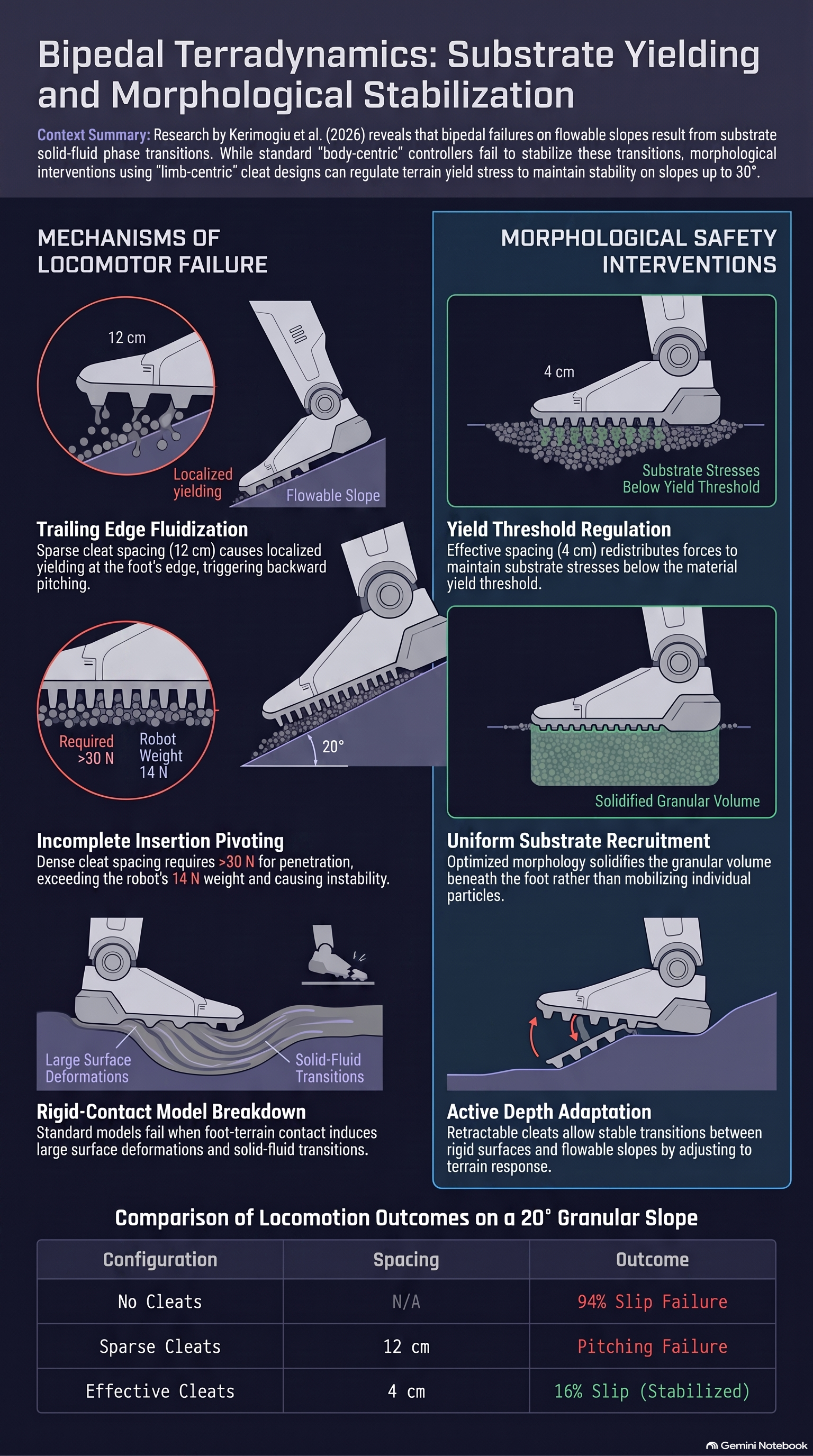
Introduction: The Fragility of Bipedal Locomotion
Bipedal robots have demonstrated remarkable stability on rigid surfaces by utilizing well-established contact mechanics and control strategies. However, these machines frequently encounter catastrophic failure when transitioning to “flowable” substrates such as sand, soil, or poppy seeds. On such terrains, the ground behaves not as a fixed platform but as a medium that deforms and flows once its yield stress is exceeded.
Traditionally, robotics research has been dominated by a “body-centric” control paradigm. This approach treats terrain-induced effects—such as a foot slipping or the ground yielding—as external disturbances to be corrected by adjusting the robot’s body motion. According to the research by Kerimoglu et al., this methodology often fails on granular slopes because it does not account for the complex coupling between the robot’s dynamics and the evolving state of the terrain.
In their study, Kerimoglu et al. propose a “limb-centric” approach to terradynamics. Rather than merely reacting to slips through software compensation, this strategy uses physical foot morphology to manipulate the substrate, preventing failure by keeping the terrain in a solid-like state. The researchers validated this approach using two primary platforms: BLUEY (a 1.4 kg robophysical model) and HECTOR (a 15 kg autonomous biped).
The Physics of Failure: Why Standard Robots Fall on Granular Slopes
The paper identifies the solid-fluid phase transition as the primary driver of locomotion failure on granular slopes. When a robot’s foot exerts force beyond a specific yield threshold, the granular material transitions from a solid-like state to a fluid-like state, causing the surface to flow downward.
Kerimoglu et al. identify two primary failure modes for long-legged robots on these surfaces:
- Pitching: The robot tips forward or backward as the substrate gives way beneath specific parts of the foot.
- Slipping: The robot loses traction and slides downslope as the grains fluidize.
The authors describe a “coupling” effect where the robot disturbs the terrain, and the resulting surface flow subsequently perturbs the robot’s motion. Bipedal robots are particularly susceptible to these instabilities due to their tall, upright morphology and limited foot contact area. Because standard rigid-contact models are insufficient for capturing these fluid-like transitions, they fail to provide a reliable foundation for stabilizing locomotion on flowable inclines.
The Goldilocks Principle of Cleat Spacing
To identify mechanisms for mitigating these failures, the authors conducted “robophysical” experiments using BLUEY on a 20-degree granular slope. They tested foot configurations utilizing “cleats”—thin plates protruding from the foot sole—to determine how morphology dictates terrain response.
The experiments revealed a nonmonotonic relationship between cleat spacing and displacement success. The results are summarized in the following table:
| Foot Configuration | Displacement (of 100 cm) | Outcome / Failure Mechanism |
|---|---|---|
| No Cleats | 6 cm (6%) | Massive Slipping: The robot failed to gain traction and slid downslope. |
| Sparse Cleats (12 cm) | Failure | Trailing Edge Failure: The robot initially climbed but failed midway along the trackway; localized fluidization at the heel led to backward pitching. |
| Dense Cleats (1 cm) | 67 cm (67%) | Incomplete Insertion: High cumulative insertion resistance and high force per plate pair prevented the cleats from fully penetrating the surface. |
| Effective Cleats (4 cm) | 82 cm (82%) | Solidification: Lowered cumulative resistance allowed full insertion; interaction forces were distributed to maintain substrate stress below the yield threshold. |
The authors utilized Particle Image Velocimetry (PIV) to visualize these interactions. They found that effective cleat spacing redistributes particle motion uniformly beneath the foot. This prevents the localized “fluidization” seen in sparse configurations and instead encourages a “solid-like” substrate response, effectively “solidifying” the ground under the robot’s weight.
Active Depth Control: Designing for Hybrid Terrains
While fixed cleats optimize performance on granular slopes, they can hinder locomotion on rigid surfaces where they cannot penetrate. To address this, Kerimoglu et al. developed a robotic foot with a retractable cleat mechanism.
The operational principle of the foot is based on active depth control. The robot uses the motor current of the cleat actuator as a “proxy for penetrability”:
- On Rigid Surfaces: A negative motor current indicates high resistance, prompting the mechanism to retract the cleats to maintain a flat profile. This is necessary to avoid pitching on surfaces where penetration is physically impossible.
- On Granular Surfaces: A positive current reading indicates the ability to penetrate, triggering the extension of the cleats to engage the “solidification” mechanism.
The authors reported that this adaptive mechanism successfully enabled BLUEY to transition between surface types. In contrast, they noted that fully extended cleats caused the robot to pitch and fail on rigid transitions, while the no-cleat configuration failed immediately upon reaching the granular section of the trackway.
Scaling the Solution: From BLUEY to HECTOR
To demonstrate that these terradynamic principles are not limited to small-scale models, Kerimoglu et al. applied their findings to HECTOR, a 15 kg autonomous biped.
The researchers modified HECTOR’s feet to incorporate the “limb-centric” lessons learned from BLUEY:
- Lateral Stability: Foot width was increased in the frontal plane to enhance lateral support and prevent side-to-side tipping.
- Cleat Depth: A 4 cm cleat depth was selected to provide traction while ensuring the cleats did not interfere with the robot’s “swing” phase.
During trials on a 15-degree granular incline, HECTOR was commanded to follow a predefined speed of 7.5 cm/s. The results mirrored the robophysical patterns: feet without cleats failed within a few steps, and while dense cleats allowed for initial velocity tracking, they eventually led to failure. The effectively spaced cleats provided the best overall performance, enabling the 15 kg robot to maintain its commanded speed and stability on the flowable slope.
Conclusion: Implications for Failure-First Research
The research by Kerimoglu et al. suggests that bipedal stability in unstructured environments is a function of physical interface design as much as control theory. The authors’ “limb-centric” strategy provides three critical takeaways:
- Morphological Intervention vs. Software Compensation: Rather than relying on algorithms to compensate for a slip after it occurs, physical design can prevent the slip entirely by regulating the state of the terrain.
- Regulating Terrain State: Stability is achieved by actively managing the environment. By distributing stresses to stay below the yield threshold, the robot dictates the state of the substrate rather than being a victim of its fluid-like flow.
- The Scalability of Terradynamic Principles: The consistency of results between the 1.4 kg BLUEY and the 15 kg HECTOR suggests that these terradynamic principles are robust across different robot scales, providing a mechanistic foundation for locomotion in natural, unpredictable environments.
Read the full paper on arXiv · PDF