Casting Everything to Online API Services? A Survey of Integrating Localized Speech Recognition Models in Robotic Systems
Surveys the integration of localized automatic speech recognition models into robotic systems across model architectures, deployment strategies, and physical platforms.
1. Introduction: The Voice-First Frontier in Robotics
Automatic Speech Recognition (ASR) has transitioned from a specialized luxury to a critical infrastructure component in modern human-robot interaction (HRI). As robots migrate from isolated industrial settings into dynamic, unstructured environments like homes and hospitals, speech serves as the most intuitive interface for human control. However, current trends favoring cloud-dependent API services introduce systemic risks regarding latency, privacy, and reliability.
In the 2026 survey, “Casting Everything to Online API Services?”, Li et al. evaluate the critical shift from cloud-centric speech processing to localized, on-device models. The authors frame this analysis through a “failure-first” AI safety lens, emphasizing that ASR is not a standalone module but the first stage in a complex perceptual pipeline. Within this framework, the authors demonstrate how upstream perceptual errors—such as misrecognized commands—propagate through the system to cause significant downstream embodied action failures. This article synthesizes Li et al.’s findings to provide a roadmap for developing resilient, voice-enabled robotic platforms.
2. The Evolution of ASR: From Manual Labels to Foundation Models
The technological landscape of ASR has moved beyond conventional hybrid architectures, such as Gaussian Mixture Models (GMM-HMM) and Deep Neural Networks (DNN-HMM), which required separate tuning for acoustic models, pronunciation lexicons, and language models. Li et al. describe the ascent of modern End-to-End (E2E) approaches, which collapse these formerly distinct modules into a single neural network that maps acoustic frames directly to output symbols.
The authors highlight the emergence of “Speech Foundation Models” as a primary driver of high-accuracy interaction:
- OpenAI’s Whisper: Pre-trained on 680,000 hours of data, utilizing a Transformer encoder-decoder architecture for robust multilingual performance.
- CMU’s OWSM Series: An open-source effort providing the OWSM v3.1 (utilizing the E-branchformer architecture) and the OWSM-CTC variant, an encoder-only model optimized for efficiency.
- Meta’s Massively Multilingual Speech (MMS): Utilizes Self-Supervised Learning (SSL) and Wav2Vec 2.0 fine-tuning to provide ASR coverage for over 1,000 languages with minimal labeled data.
- Julius Speech Foundation Model: A project highlighted by the authors for its modular, real-time design that integrates classical decoding frameworks with modern neural representations.
Li et al. note that the barrier to entry has been lowered by a mature ecosystem of open-source toolkits and datasets, including Kaldi (finite-state transducers), ESPnet (E2E recipes), and SpeechBrain (PyTorch-based framework). Key training corpora cited include LibriSpeech (1,000 hours), CommonVoice (multilingual crowdsourcing), and Gigaspeech (10,000+ hours of multi-domain audio).
3. Architectural Trade-offs: Onboard, Cloud, and Hybrid Deployments
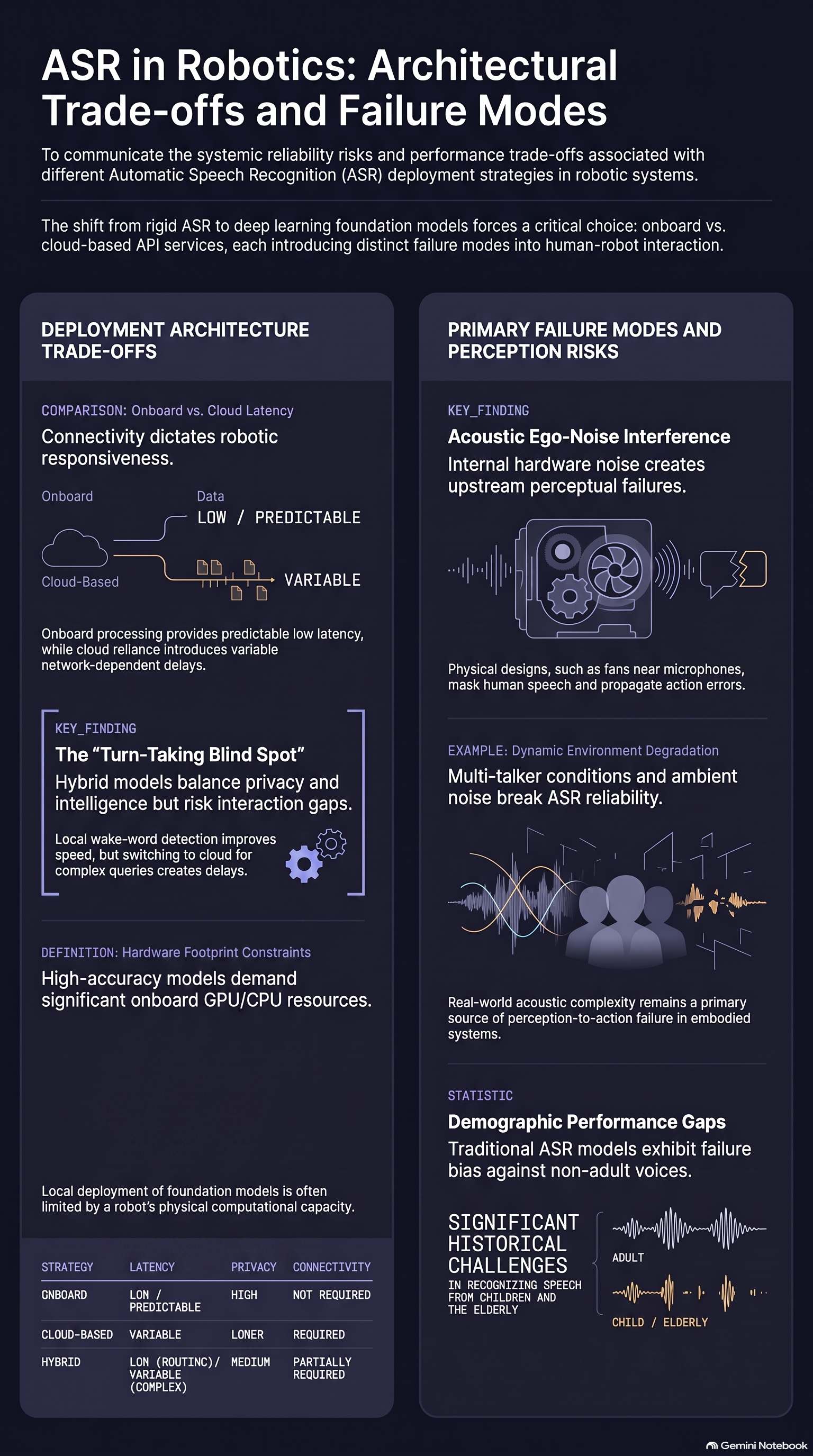
Integrating ASR into robotics requires balancing hardware constraints against the need for linguistic depth. Li et al. synthesize three primary deployment strategies, categorized by their impact on robot autonomy and responsiveness.
| Strategy | Latency | Privacy | Connectivity | Typical Robotic Fit |
|---|---|---|---|---|
| Onboard | Low and predictable | High | Not required | Offline, privacy-sensitive, or time-critical command and control. |
| Cloud-based | Variable; network-dependent | Lower | Required | Open-domain interaction and access to larger, frequently updated services. |
| Hybrid | Low for routine; variable for complex | Medium | Partially required | Balance fast local control with cloud support for richer language tasks. |
The authors examine the role of the Robot Operating System (ROS/ROS2) in managing these models. They identify packages for PocketSphinx (lightweight command-and-control) and Vosk (an offline API based on Kaldi) as essential for real-time, on-device processing. Newer ROS2 nodes are also identified as critical for optimizing heavy models like Whisper for local execution on robotic edge hardware.
4. Robotics in the Real World: A Survey of Voice-Enabled Platforms
Li et al. categorize current platforms by their ASR implementation, illustrating how specific use cases dictate architectural choices.
Social and Personal Robots The authors examine robots like Pepper, designed for customer service, which uses onboard microphones to recognize human emotion via tone. They contrast this with Misty II, which allows developers to toggle between offline keyword spotting and cloud-based complex tasks. Mobile assistants such as Temi and Amazon Astro are identified as front-ends for established cloud ecosystems (Amazon Alexa), while the Anki Vector utilizes a hybrid approach—onboard wake-word detection (“Hey Vector”) followed by cloud-based request processing.
Humanoid and Mobile Platforms In the humanoid sector, the authors analyze the anticipated needs of Tesla’s Optimus, noting that household or factory utility will depend on robust, likely Transformer-based ASR (e.g., Whisper). For Boston Dynamics’ Spot, the authors observe that while primarily teleoperated, developers have integrated ASR to enable hands-free operational commands in industrial or search-and-rescue environments.
Comparative Domain Analysis Li et al. provide a parallel analysis of the automotive sector, specifically platforms like Cerence and Houndify. These systems utilize domain-specific, hybrid ASR to ensure that safety-critical commands (navigation/climate) remain functional offline, while offloading general information queries to the cloud.
5. Engineering the Future: Navigating Failure Modes and Challenges
Despite recent advancements, Li et al. identify four primary technical hurdles that result in systemic perceptual failures:
- Acoustic Noise and “Ego-Noise”: Robots generate significant internal mechanical noise. The authors cite the NAO robot as a classic example of hardware failure, where microphone placement near cooling fans severely degraded recognition.
- Speaker Diversity: Current models frequently fail when interacting with children, the elderly, or speakers with non-standard accents, necessitating more representative training data.
- The Latency Gap: Network delays in cloud-based systems create a “turn-taking blind spot.” Citing Skantze & Irfan (2025), the authors characterize this as a fundamental failure in conversational flow and timing that renders natural interaction impossible.
- Contextual and Multimodal Understanding: The authors argue that transcription alone is insufficient for safety. Spoken Language Understanding (SLU) must be fused with Large Language Models (LLMs) and Task Planners to ground commands. Without this grounding, a robot cannot safely resolve ambiguous instructions like “pick that up.”
6. Conclusion: Toward Robust Multimodal Interaction
Li et al. conclude that no single deployment strategy is universally superior; the optimal architecture is determined by the specific hardware footprint and the necessity of real-time responsiveness. The authors suggest that standalone ASR modules are becoming obsolete, to be replaced by End-to-End Multimodal Interaction systems. These future systems will fuse speech with gaze, gesture, and scene context to output direct embodied actions rather than mere text. This integration is essential for moving beyond simple transcription toward seamless embodied intelligence.
Key Takeaways for Developers
- Adopt Hybrid Architectures: Reserve cloud APIs for open-ended queries while using local wake-word and command processing to ensure privacy and safety-critical responsiveness.
- Design for Ego-Noise Mitigation: Address hardware-generated sound through strategic microphone placement and digital beamforming to prevent upstream perceptual errors.
- Prioritize Multimodal Grounding (ASR-Vision Fusion): Transition away from standalone ASR; link speech output to vision and behavior planning to resolve physical ambiguities and ensure safe task execution.
Read the full paper on arXiv · PDF