FlowDAgger: Human-in-the-Loop Adaptation of Generative Robot Policies in Latent Space
The paper presents FlowDAgger, a method that adapts frozen generative robot policies to out-of-distribution tasks by mapping human intervention actions into latent noise to train a lightweight...
1. Introduction: The “Last Mile” Problem in Robotic Deployment
Modern robot foundation models, including Vision-Language-Action (VLA) models and World-Action Models (WAM), possess impressive behavioral priors. By leveraging large-scale demonstration datasets, these models can often transfer skills across various embodiments. However, Murray et al. observe that real-world deployment frequently encounters a “last mile” hurdle: “out-of-distribution” (OOD) scenarios. Unfamiliar objects, novel scene dynamics, or specific hardware quirks often cause these generative models to fail in the field.
Closing these performance gaps traditionally requires autonomous trial-and-error, a hallmark of reinforcement learning that is often unsafe for physical hardware due to the risk of damage. Alternatively, large-scale data collection for retraining is both tedious and slow. The authors present FlowDAgger as a solution that “steers” rather than “rewrites” the robot’s generative brain, allowing for rapid adaptation without the risks or costs associated with retraining large-scale models.
2. The Failure of Traditional Adaptation
The paper argues that the specific interface used for adaptation—whether it targets model weights, action outputs, or latent noise—is critical for stability and efficiency. The authors contrast FlowDAgger against three existing methodologies:
- Supervised Fine-Tuning (SFT): This method updates the generative policy’s weights using offline demonstrations. The authors note this is computationally expensive and frequently leads to “skill erosion,” where new training on a specific task corrupts the model’s broader pre-existing capabilities.
- Action-Space Residuals: This approach keeps the base model frozen and learns an additive correction in the action space. However, because these corrections are unconstrained, they can push the policy “off-manifold,” resulting in behaviors that the base model cannot reliably sustain.
- Latent-Space RL (DSRL): While DSRL trains a controller in the noise space, the authors find it sample-inefficient for real-world use. It relies heavily on sparse reward signals and autonomous exploration, which remain significant bottlenecks during physical deployment.
The authors conclude that the adaptation interface is the deciding factor: weight-space updates damage the prior, and action-space corrections lack the necessary constraints to remain stable.
3. The FlowDAgger Mechanism: Action Inversion
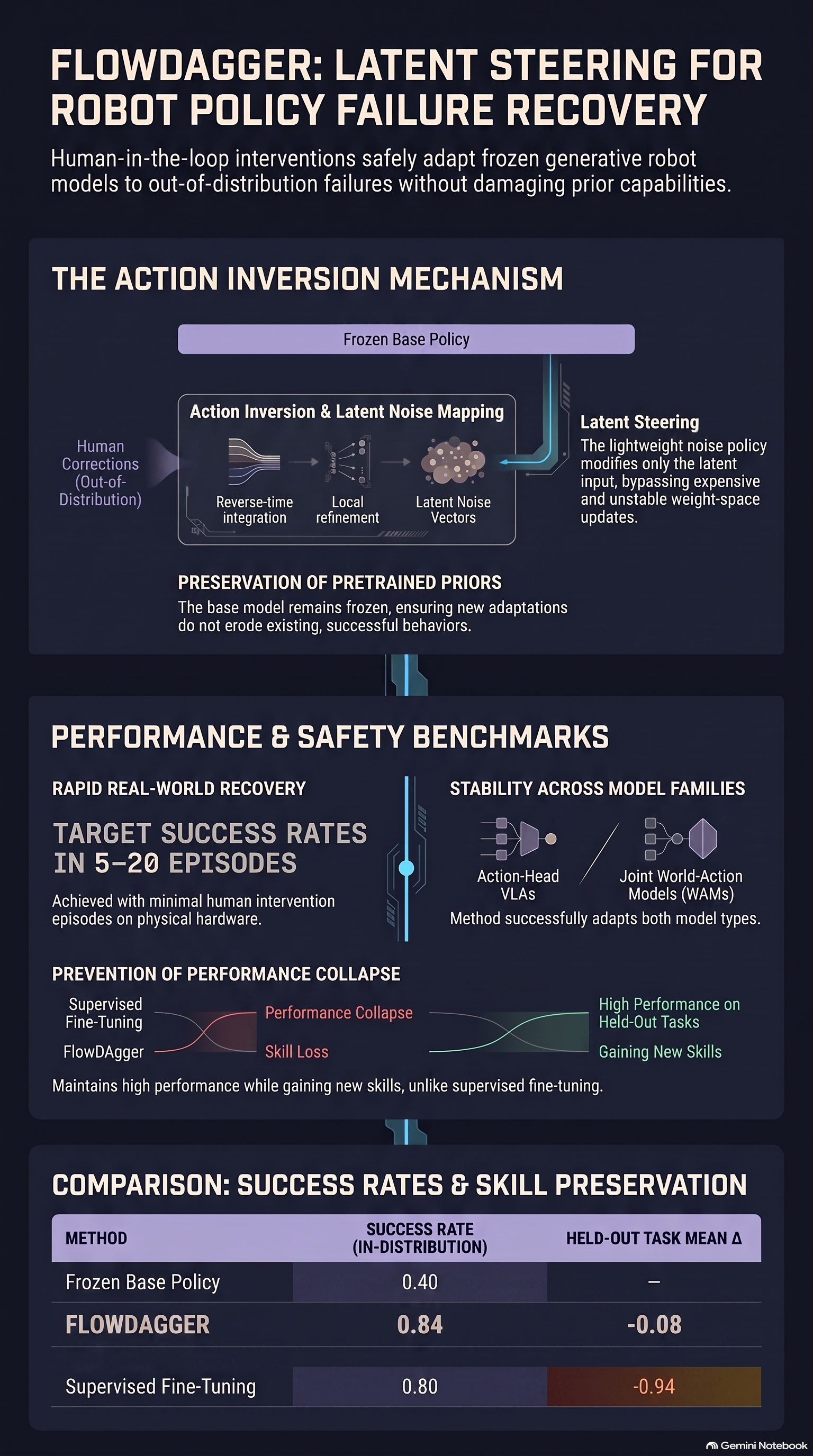
The core technical innovation of FlowDAgger is the Action Inversion process. This mechanism maps human expert actions back to the specific latent noise () that would have produced them under the frozen base policy.
The Two-Step Mathematical Approach
Because the mapping from noise to action has no closed-form inverse, the authors employ a two-step approach:
- Reverse-Time Integration: This step undoes the Euler steps used during the base policy’s generative pass.
- Local Refinement: The authors solve an implicit equation via fixed-point iteration to ensure accuracy. The paper specifies the use of iterations for this refinement.
The authors emphasize that explicit reverse passes are insufficient because they suffer from errors. While these discrepancies are negligible in image diffusion, they are disproportionately large compared to the small, precise actions required in robotic control. This workflow allows human interventions () to be converted into latent-space supervision ().
The Lightweight Steering Policy ()
The inverted noise provides supervision for a Lightweight Steering Policy. This is the only component trained, leaving the foundation model’s weights () completely frozen. By supervising the latent decisions rather than modifying parameters, the model maintains its underlying generative capabilities.
4. Adapting Different Architectures: From VLAs to World Models
FlowDAgger is designed to be architecture-agnostic, functioning across different generative model families as shown in the table below:
| Model Family | Example | Inversion Target |
|---|---|---|
| Vision-Language-Action (VLA) | , Gr00t N1.7 | Action-head noise space |
| World-Action Model (WAM) | Cosmos-Policy | Joint world-action latent sequence |
For World-Action Models like Cosmos-Policy, the authors implement Joint Inversion. Because actions are entangled with future-state predictions in these models, the authors use a “minimal-delta swap” to build the inversion target. They swap only the action frame while holding the predicted state and value frames fixed to the base policy’s outputs, ensuring the policy stays “on-manifold.” To handle the resulting high-dimensional noise, the steering policy regresses PCA-based basis parameters, anchoring the output to a manageable manifold of successful behaviors.
5. Empirical Evidence: Faster, Leaner, and Safer
The authors evaluated FlowDAgger in MetaWorld simulations and on real-world hardware, including the FR3 Duo and Dual UR5e platforms.
Key Performance Takeaways
- Sample Efficiency: FlowDAgger reaches target success rates with significantly fewer interventions than SFT or DAgger. On the Toolbox Packing task, the success rate improved from 13% to 80% with only ten interventions.
- Compute Efficiency: Adaptation is lightweight enough to fit on a single consumer GPU with approximately 8 GB of VRAM, as shown in Figure 4.
- Capability Preservation: The authors report that FlowDAgger prevents catastrophic forgetting.
According to Table 3 in the paper, after being adapted for a specific task, FlowDAgger maintained a mean success rate of 0.88 on held-out tasks, whereas SFT caused performance on those same tasks to collapse to 0.02.
The real-world utility of the method is showcased in contact-rich and bimanual tasks. These include the bimanual coordination required for Toolbox Packing, the precision needed for Glassware Stacking, and other complex manipulations like Plug Insertion, Jenga Stacking, and the BusyBox benchmark.
6. Critical Limitations and Constraints
The authors identify three primary boundaries for the FlowDAgger method:
- Manifold Constraint: The desired corrective behavior must be representable within the base policy’s existing action manifold.
- Supervision Quality: The method is entirely dependent on the accuracy and coverage provided by the human expert.
- Dynamics Conditioning: Inversion accuracy may degrade in scenarios involving highly multi-modal action distributions or poorly conditioned generative dynamics.
7. Conclusion: A New Paradigm for Human-Robot Interaction
FlowDAgger represents a shift in AI adaptation for physical embodiments. By treating human interaction as a way to supervise latent decisions rather than modifying billions of parameters, the authors have successfully decoupled adaptation from model scale. This allows robot foundation models to remain stable, reusable, and practical for real-world deployment.
Final Takeaways
- Action Inversion enables human corrections to be used as high-fidelity supervision in latent space by employing fixed-point iterations to overcome integration errors.
- Frozen Base Weights ensure that the model retains its behavioral priors, preventing the “skill erosion” common in Supervised Fine-Tuning.
- High Efficiency allows the system to be adapted on consumer-grade hardware (~8 GB VRAM) using minimal real-world intervention data.
- Versatility is demonstrated through successful deployment on both VLA and WAM architectures, as well as on bimanual hardware like the FR3 Duo.
Read the full paper on arXiv · PDF