Safe Reinforcement Learning using Ideas from Model Predictive Control
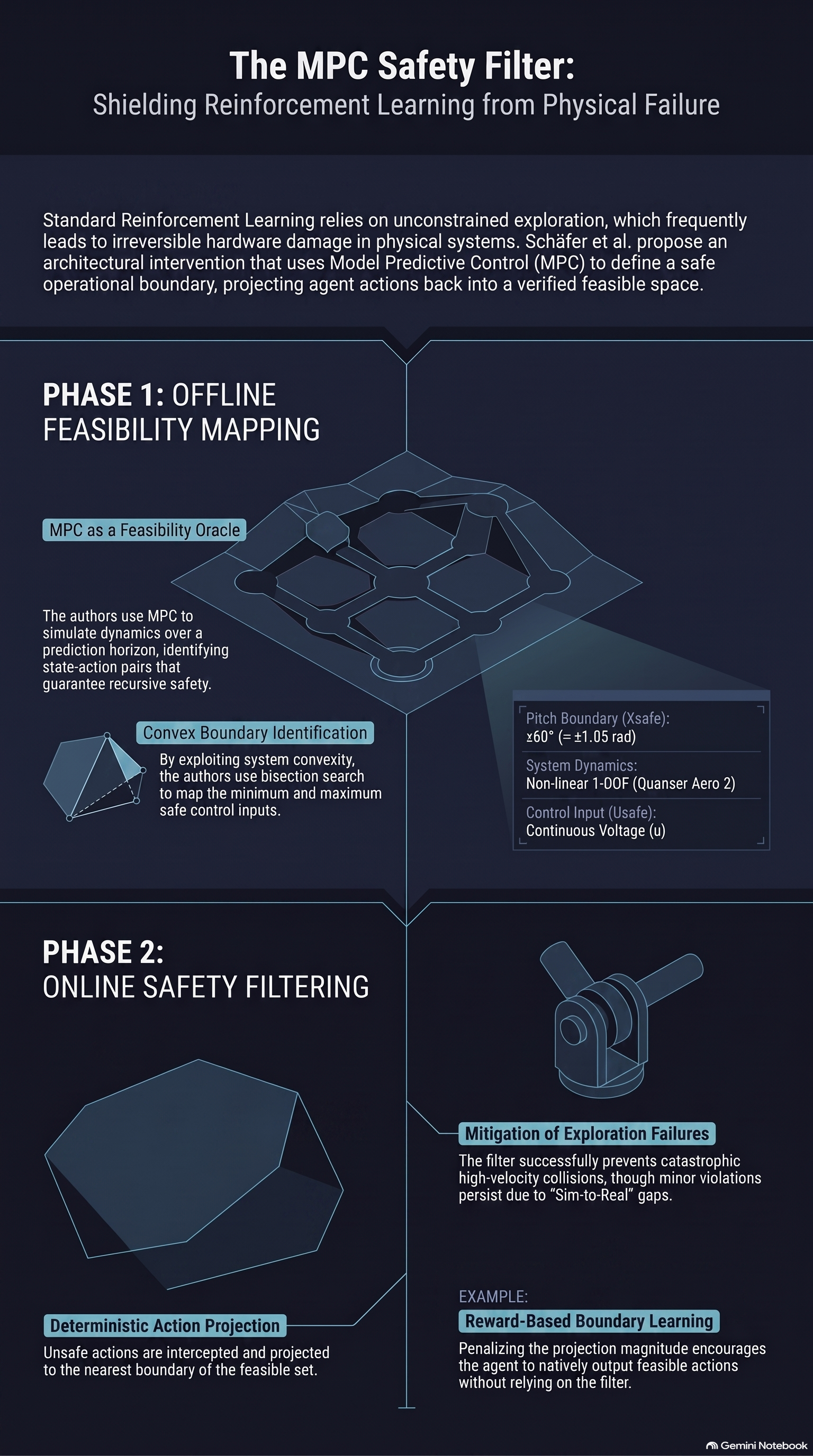
The authors propose a safe reinforcement learning framework that projects active RL actions onto an offline MPC-derived feasible state-action set to enforce hard safety constraints on hardware.
1. Introduction: The High Stakes of Physical Exploration
In the domain of Reinforcement Learning (RL) for robotics and cyber-physical systems (CPS), researchers are confronted by the “Safe Exploration Paradox.” To optimize control policies, an agent must engage in the stochastic exploration of the state-action space. However, for physical hardware, this unconstrained trial-and-error process is often catastrophic. For high-inertia systems, a single exploratory action can lead to irreversible damage before a controller can intervene.
Schäfer et al. propose a framework to resolve this by bridging high-performance Deep Reinforcement Learning (DRL) with the deterministic safety guarantees of Model Predictive Control (MPC). By utilizing MPC as an offline safety oracle, the authors pre-compute a feasible state-action space, ensuring that exploration remains within mathematically verified boundaries. This report by Failure First examines how shifting the computational burden from real-time loops to offline verification enables safe learning on physical hardware.
2. The Problem: Why Standard RL Fails Cyber-Physical Systems
Standard RL agents optimize for scalar rewards but lack a fundamental understanding of physical dynamics and safety boundaries. The authors identify a critical threshold known as the “Point of No Return,” formally defined as the boundary of the feasible set (). This occurs when a system, due to its inertia, enters a state from which the available control authority () is insufficient to prevent a future constraint violation.
Satisfying single-step constraints—simply checking if the next state is safe—is insufficient for CPS. The system may already be on an inevitable trajectory toward failure even if the immediate next step appears valid. Unconstrained exploration poses three primary physical risks:
- Mechanical Limits: Exceeding joint ranges of motion or structural load capacities.
- Thermal Bounds: Overheating of actuators or electronics due to excessive current or friction.
- Actuator Constraints: Physical limits on motor voltage or torque that restrict corrective effort.
3. Core Concept: The Feasible State-Action Space ()
The framework relies on the mathematical definition of a global feasible state-action space, denoted as . A state-action pair is defined as “safe” only if it does not lead to an unsafe state where a future violation becomes inevitable. The authors define using a binary oracle function:
The oracle determines safety by checking if an MPC optimizer can find a valid sequence of future actions where the first action is . This safety is verified over a prediction horizon . To ensure recursive feasibility, the authors specify that must be sufficiently large—specifically, it must exceed the “stopping distance” or the time required to bring the system to a complete halt using maximum opposing effort.
4. Efficiency via Physics: Scaling the Offline Mapping
To avoid the “curse of dimensionality” during the offline phase, the authors do not perform an exhaustive search of the entire continuous space. Instead, they utilize a systematic grid search for the discretized state space and exploit the physical properties of control-affine dynamics. In such systems, control inputs enter the dynamics linearly, allowing safety constraints to map to linear inequalities with respect to the action space. This ensures that the set of feasible actions for any given state, , forms a continuous, convex interval.
The authors utilize a Bisection Search to map the continuous action space efficiently:
- Identify Monotonicity: Exploiting the monotonic relationship between input (e.g., rotor voltage) and thrust.
- Determine Boundaries: Querying the oracle to identify only the minimum () and maximum () safe action boundaries for a given state.
- Establish Convexity: Because the action space is convex, any action satisfying is intrinsically guaranteed to be safe.
5. The Safety Filter: Implementing the Projection Mechanism
During training and deployment, the RL agent interacts with the CPS through a deterministic projection filter (). This filter intercepts raw actions () before they reach the hardware and maps them to the nearest safe action in the set .
The operational logic is defined as:
For a proposed action , the filter executes:
This ensures is projected to the nearest Euclidean boundary of the safe set if it is found to be unsafe. To encourage the agent to learn these boundaries natively, the authors penalize the magnitude of this projection in the reward function. Additionally, to prevent “bang-bang” control (high-frequency oscillations), the reward includes an action penalty calculated using the standard deviation of the normalized applied action over a sliding window.
6. Empirical Validation: The 1-DOF Helicopter Testbed
The authors validated the framework using a Quanser Aero 2 configured for 1-degree of freedom (1-DOF) pitch control. The system used mechanical pitch limits of 60°. While the filter successfully prevented catastrophic failures, the authors noted rare, intermittent violations on physical hardware.
| Theoretical Safety Guarantees | Empirical Realities (Sim-to-Real Gap) |
|---|---|
| Recursive Feasibility: Verified over stopping distance horizon . | Model Inaccuracies: Nominal mathematical models deviating from true physical dynamics. |
| Constraint Satisfaction: Deterministic bounds derived from the oracle. | Sampling Errors: Continuous-time violations occurring between discrete-time evaluation steps. |
| Zero-Latency Execution: Mathematically idealized control loops. | Numerical Solver Tolerances: Errors introduced by the precision limits of real-time Euclidean projection. |
| Global Verification: Pre-computed safety via offline mapping. | Communication Latency: Minor delays in signal transmission between controller and hardware. |
7. Conclusion: Key Takeaways for AI Safety Practitioners
Schäfer et al. demonstrate that shifting safety verification to an offline pre-computation phase allows RL agents to explore complex environments without exposing hardware to the “Point of No Return.”
Key Takeaways:
- Predictive over Reactive: Forward-looking MPC horizons are required for high-inertia systems where reactive “shields” often intervene too late to prevent collisions.
- Computational Efficiency: Exploiting system physics (such as the convexity of control-affine dynamics) allows for efficient bisection searches, making safety mapping feasible.
- The Sim-to-Real Challenge: Even mathematically verified filters face intermittent violations due to unmodeled dynamics and solver tolerances, requiring robust MPC formulations.
- Scaling Future Research: The authors suggest that future iterations could replace grid searches with Gaussian Processes (GPs) to scale this safety filtering to higher-dimensional systems.
8. References and Attribution
- Schäfer, G., Rehrl, J., Huber, S., & Hirlaender, S. (2026). “Safe Reinforcement Learning using Ideas from Model Predictive Control.” arXiv:2607.07252.
This article is a report by Failure First on the methods and findings presented by Schäfer et al. Read the full paper on arXiv · PDF