Qwen-RobotWorld Technical Report: Unifying Embodied World Modeling through Language-Conditioned Video Generation
We introduce Qwen-RobotWorld, a language-conditioned video world model for embodied intelligence.
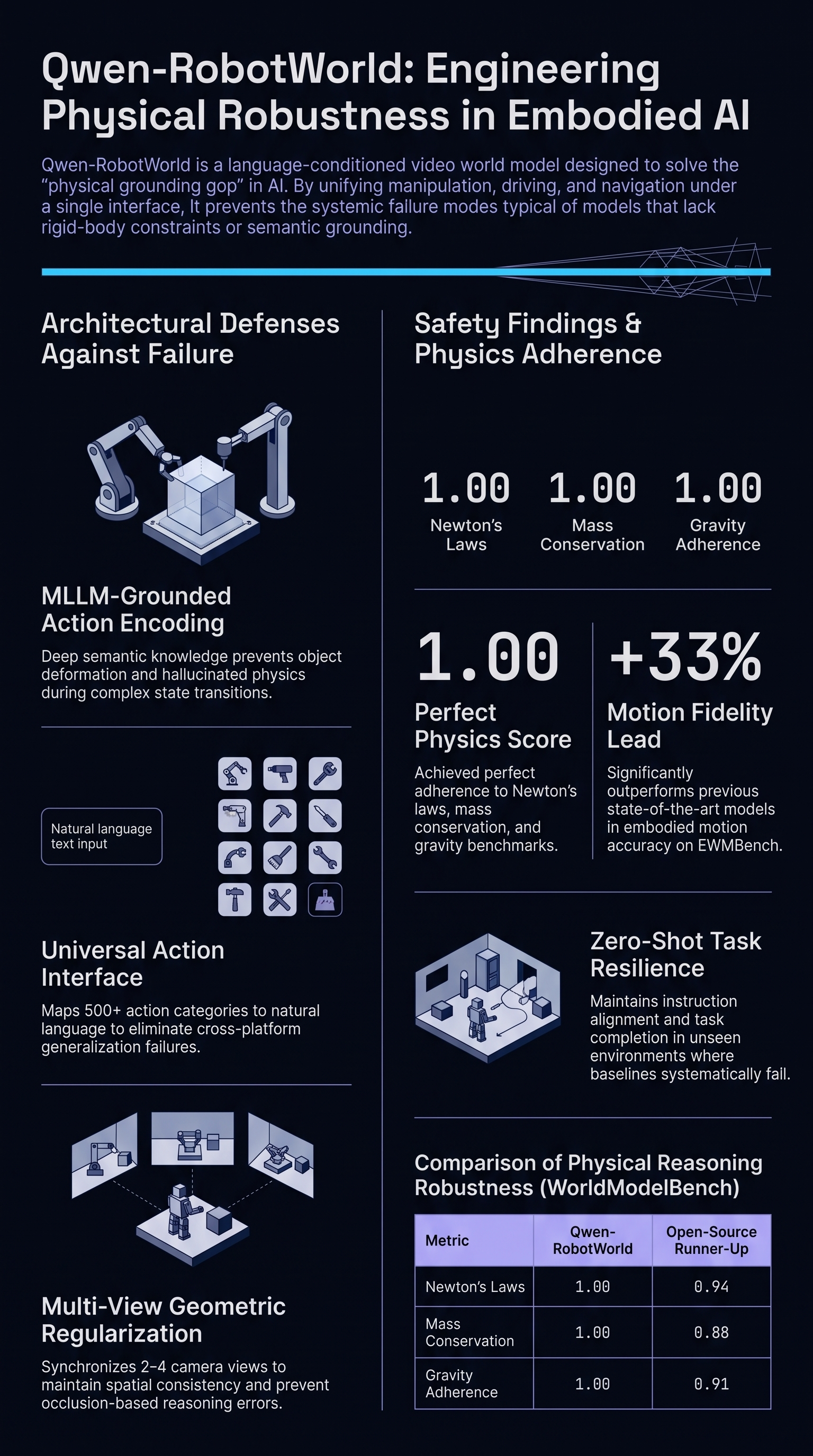
1. The “Safety-First” Introduction: Why Physical Simulation Matters
The pursuit of embodied intelligence is currently hindered by a fundamental tension between scale and physical fidelity. General-purpose video models, while rich in visual priors, frequently fail to respect basic physical laws, leading to “hallucinated” dynamics. Conversely, domain-specific models that maintain physical grounding typically lack the scalability to generalize across diverse robot platforms. Training agents directly in the real world to bridge this gap remains prohibitively expensive and carries significant safety risks.
Qwen-RobotWorld resolves this dilemma by serving as a language-conditioned video world model that acts as a universal simulation backbone. By internalizing environment dynamics from vast observational data, it provides a “failure-first” platform. This allows researchers to red-team AI systems and refine their responses to unexpected physical failures in a risk-free virtual space before any real-world deployment. Crucially, the model’s adherence to physical laws is not just a feature—it is a prerequisite for valid safety evaluation.
Mission Statement To provide a scalable, risk-free simulation backbone that bridges high-fidelity visual priors with physically grounded state transitions, enabling robust embodied intelligence through safety-first training and evaluation.
2. The Language Interface: A Universal Remote for Robotics
Traditional robotics often relies on “brittle” hardware-specific commands, such as joint angles or end-effector waypoints, which require bespoke interfaces for every new robot. Qwen-RobotWorld shifts this paradigm by using natural language as a unified action interface. This choice allows the model to function as a universal state transition function:
Where is the current visual observation, is the natural language action, and is the predicted future state.
Strategically, natural language serves a dual role: it is an explicit input to govern state transitions and a post-hoc output inferred from video to serve as automated action labels. This unified formulation enables three primary application directions:
- Synthetic Data Generation: Augmenting policy training by generating diverse execution videos that bridge the data scarcity gap.
- Virtual Environments: Creating scalable, high-fidelity platforms for closed-loop policy evaluation and safety red-teaming.
- Planning Signals: Providing language-guided visual “look-ahead” to inform downstream robot control and decision-making.
3. Architectural Deep-Dive: The Double-Stream MMDiT
The architectural core of Qwen-RobotWorld is a 60-layer Double-Stream Multimodal Diffusion Transformer (MMDiT) with 20 billion parameters. It meticulously couples deep semantic understanding with high-fidelity video generation using three components:
- Action Encoder: A frozen Qwen2.5-VL (7B) that parses complex, compositional language instructions.
- State Encoder/Decoder: A Wan-VAE that handles latent representations of video frames.
- Transition Function: The MMDiT backbone that fuses the “Understanding Stream” (semantics) and “Generation Stream” (visual latents) via joint attention at every layer.
The strategic use of an MLLM like Qwen2.5-VL as an action encoder provides a critical advantage over lighter models like T5 or CLIP. Because the MLLM possesses internalized world knowledge, it understands that robot arms are rigid bodies with fixed link lengths. This semantic grounding prevents “object deformation”—a common failure in video models where objects fluidly change shape during motion—ensuring that a robot arm maintains its structural integrity across frames.
To manage the complexity of high-resolution video, the model employs an asymmetric 3D Rotary Position Encoding (RoPE) split:
| Dimension | Allocated Dimensions | Rationale |
|---|---|---|
| Temporal | 16 | Adjacent frames are strongly correlated, requiring fewer dimensions. |
| Spatial Height | 56 | Captures high diversity in object verticality and scene depth. |
| Spatial Width | 56 | Captures scene layout complexity and horizontal trajectories. |
4. The EWK Dataset: 8.6 Million Reasons Why It Works
The model’s generalization capabilities are rooted in the Embodied World Knowledge (EWK) dataset, a massive corpus of 8.6 million video-text pairs (over 200 million frames). The mixture is strategically balanced to ensure both depth of physical reasoning and breadth of scenario coverage.
| Domain | Embodiment | Tasks / Views | Contribution |
|---|---|---|---|
| Manipulation | Franka, Aloha, Humanoids, Dexterous Hands | Pick-and-place, pouring, folding; Synced Ego + Wrist + External | Fine-grained contact physics, rigid/deformable body dynamics, and dexterity priors. |
| Autonomous Driving | Ego Vehicle (Waymo, Bench2Drive) | Urban traffic, multi-agent dynamics; 5–8 Surround-view cameras | Large-scale ego-motion, 3D scene geometry, and occlusion handling. |
| Indoor Navigation | Mobile Agents (VLNVerse) | Room-scale spatial reasoning; Egocentric trajectories | Language-to-trajectory alignment and obstacle-aware planning. |
| Human-to-Robot | Human → 14 Robot Morphologies | Cross-embodiment video editing; Egocentric bimanual | Bridging the photometric gap and enabling transfer from human demonstrations. |
5. Decoding Reality: The Five-Layer Hierarchical Annotation
To convert raw observational data into “action-rich” representations, Qwen-RobotWorld utilizes a rigorous five-layer annotation methodology. Every sample is filtered through four quality control principles: Operation Focus, Viewpoint Definition, Objectivity, and Physical Verifiability.
Behind the Scenes: The Five Annotation Layers
- Task Goal Layer: Identifies the high-level intent and desired state transition.
- Action Detail Layer: Decomposes actions into spatio-temporal trajectories and micro-actions (e.g., approach, rotate) with explicit viewpoint declarations.
- Physical Feedback Layer: Describes visually verifiable outcomes like displacement, deformation, or contact state changes.
- Comprehensive Caption: A 50–100 word specification of the viewpoint-agent-action-feedback quadruple.
- Concise Caption: A 15–30 word instruction-style summary for high-level inference.
6. Scene2Robot: The Magic of Cross-Embodiment Synthesis
The Scene2Robot mechanism is a breakthrough solution for the data scarcity problem in robotics. It allows the model to perform human-to-robot transfer by repurposing the MMDiT backbone for multi-segment conditioning. The input sequence is split into three segments: Scene condition (original video with hands masked), Robot reference (MuJoCo-rendered trajectory), and Generation (noisy latents).
This mechanism is essential for bridging the “photometric gap”—the visual difference between simplified simulation renders and real-world observations:
- Physical Realism: The model uses the MuJoCo trajectory as a kinematic guide but synthesizes photorealistic textures and materials for robot models like the Franka Emika Panda, AgileX Split Aloha, or ARX Lift2.
- Environmental Integration: It generates realistic shadows, lighting, and specular reflections that match the source scene, which simplified renderers ignore.
- Morphological Generalization: By attending to both the scene and the robot reference, the model can “retarget” a human motion to any of 14 different robot morphologies without bespoke prompting.
7. Benchmarking Performance: Dominating the Leaderboards
Qwen-RobotWorld demonstrates state-of-the-art performance across the embodied AI landscape. Notably, it achieves perfect physics adherence scores on WorldModelBench, accurately modeling Newton’s laws, mass conservation, and gravity. These “perfect” scores are the technical foundation of our safety mission: without respecting these laws, a world model cannot reliably simulate the “failure-first” scenarios required for robust red-teaming.
| Benchmark | Ranking | Key Metric Leads |
|---|---|---|
| EWMBench | 1st Overall | +33% motion fidelity lead (HSD 0.566) over the runner-up. |
| WorldModelBench | 1st (Open Source) | Perfect scores in physics adherence (Newton’s laws, mass conservation). |
| DreamGen Bench | 1st Overall | Excellence in object-level compositional generalization across robot subsets. |
| PBench | 1st (Open Source) | 0.990 score in motion smoothness; 3rd overall in domain understanding. |
8. Conclusion: Takeaways for the Future of Embodied AI
Qwen-RobotWorld establishes a new paradigm for a universal simulation backbone. Through a General + Expert progressive training curriculum, it balances the broad visual wisdom of internet-scale data with the precise, rigid-body constraints required for robotics.
Key Takeaways
- Universal Action Interface: Natural language serves as a two-way interface for both conditioning (input) and action labeling (output), eliminating hardware-specific engineering.
- Rigid-Body Semantic Grounding: By utilizing Qwen2.5-VL, the model prevents object deformation, ensuring that complex robot morphologies maintain structural integrity during tasks.
- Safety Through Physics: Perfect adherence to Newton’s laws on WorldModelBench enables the model to serve as a high-fidelity environment for “failure-first” safety red-teaming.
- Cross-Scenario Generalization: Joint training across manipulation, driving, and navigation allows the model to leverage “complementary physical knowledge” for superior zero-shot performance.
Read the full paper on arXiv · PDF