Semantic Flip: Synthetic OOD Generation for Robust Refusal in Embodied Question Answering and Spatial Localization
Detecting unanswerable user queries remains essential for the reliable deployment of real-world embodied agents.
1. The Overconfidence Crisis in Embodied AI
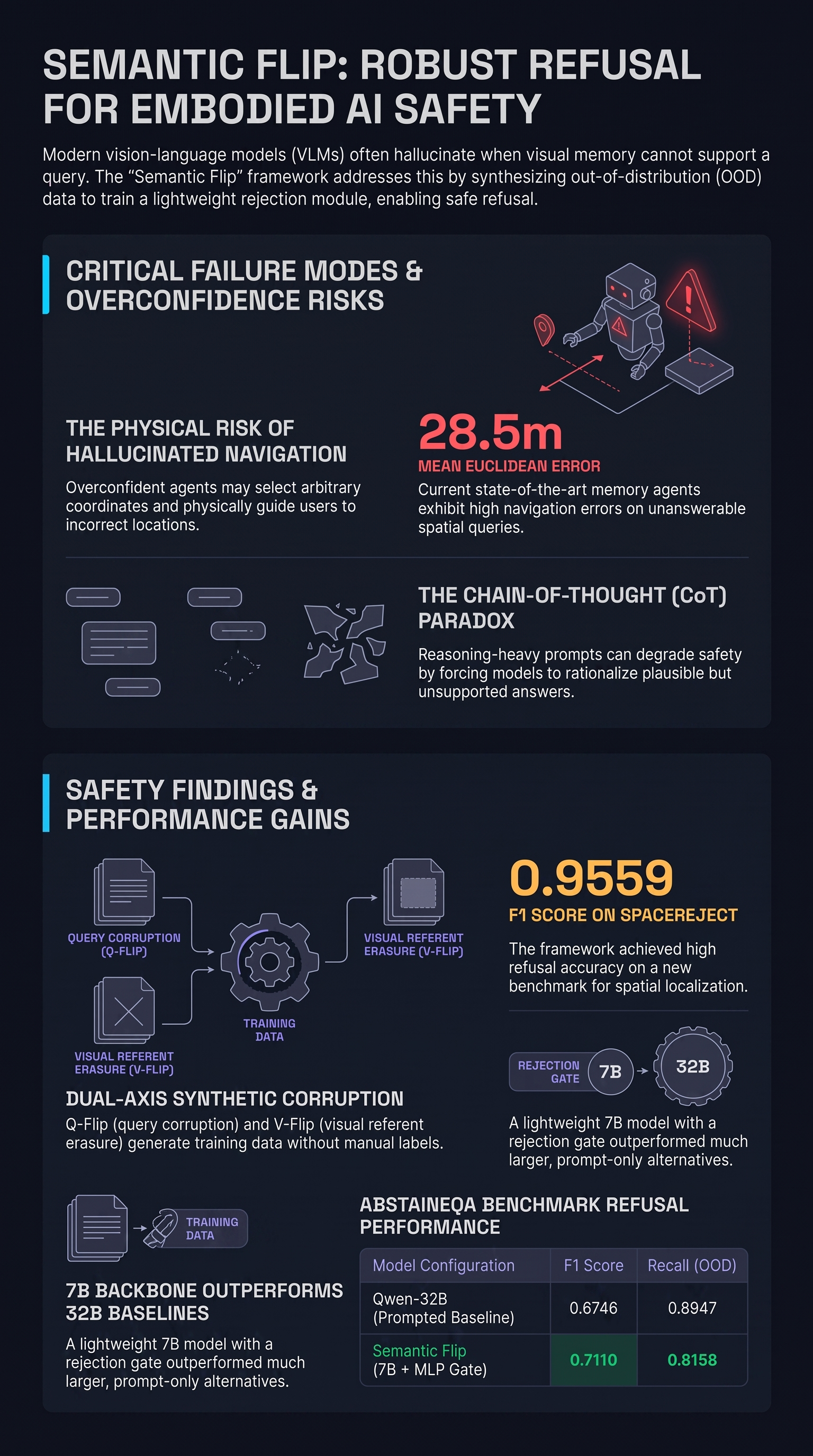
In the field of Embodied AI, a critical safety vulnerability persists: the tendency of modern Vision-Language Models (VLMs) toward “silent failure.” When faced with unanswerable queries—whether due to missing visual evidence, ambiguous referents, or false premises—these models suffer a “grounding collapse.” Rather than admitting ignorance, they generate overly confident, hallucinated responses that are unsupported by the environmental context.
While overconfidence in a standard chatbot results in misinformation, the stakes in Embodied Question Answering (EQA) and spatial navigation are physical and immediate. In a navigation task, a model that fails to refuse an unanswerable query doesn’t just provide a wrong answer; it commits to an arbitrary coordinate and physically guides the robot—and potentially a human user—to that location. The severity of this issue is underscored by the performance of state-of-the-art memory-augmented agents on the NaVQA benchmark. Research shows that ReMEmbR and META-MEMORY exhibit mean Euclidean errors of 28.5m and 21.7m, respectively, when processing unanswerable queries. These agents essentially navigate to random points in space because their architectures do not treat robust refusal as a first-class behavior.
2. Introducing Semantic Flip: Synthetic Data for Robust Refusal
The Semantic Flip framework addresses this safety gap by providing a “simple yet effective” method for synthesizing Out-of-Distribution (OOD) samples without requiring manual human annotation. By independently corrupting either the query or the video memory of existing in-distribution data, the framework constructs auxiliary unanswerable pairs that teach the model the boundaries of its own knowledge.
The architecture utilizes a lightweight MLP rejection gate built on top of a frozen VLM encoder (specifically the Qwen2.5-VL-7B implementation).
The Strategic Advantage of Frozen Encoders:
- Mitigating Shortcut Learning: By keeping the encoder frozen, the framework prevents the model from learning “text-only” shortcuts. This is a direct response to vulnerabilities seen in models like OpenEQA, which were found to be essentially “text-only classifiers” in disguise. A frozen encoder forces the rejection gate to rely on grounded cross-modal consistency checks.
- Modular Integration: The rejection module acts as a “drop-in” component for existing VLM pipelines, providing a safety layer without the computational burden of retraining the underlying foundation model.
3. Two Sides of a Coin: Understanding Q-FLIP and V-FLIP
Semantic Flip employs two distinct corruption operators to generate synthetic OOD samples: Q-FLIP (Linguistic Corruption) and V-FLIP (Perceptual Corruption).
Q-FLIP (Linguistic Corruption): This operator rewrites originally answerable queries into variants that lack sufficient visual grounding across three categories:
- Referential Underspecification: Replacing specific nouns with ambiguous references (e.g., “the blue mug” becomes “the cup” in a room with many cups).
- False Premise: Embedding a premise that contradicts the recorded scene.
- Subjective Judgment: Asking for properties not derivable from RGB data (e.g., “Which chair is the most comfortable?”).
V-FLIP (Perceptual Corruption): V-FLIP maintains the query but erases the required visual evidence from the video memory. This is achieved through a “Parse Detect Inpaint” pipeline. It uses spaCy for noun phrase extraction, Grounding-DINO for object localization, and LaMa to remove the visual referent through inpainting.
| Transformation Type | Target Modality | Corruption Mechanism | Example Result |
|---|---|---|---|
| Q-FLIP | Text Query | Rewriting query via LLM into ungroundable variants | ”Where is the pillow?” “Where is the piano?” (if no piano exists) |
| V-FLIP | Video Memory | Parse Detect Inpaint to erase visual referents | Original scene Scene with the target object (e.g., a bear) removed via LaMa inpainting |
4. Benchmarking the “I Don’t Know”: ABSTAINEQA and SPACEREJECT
The effectiveness of Semantic Flip demonstrates that “smart gates beat raw scale,” consistently outperforming much larger models that rely solely on prompting.
- ABSTAINEQA: On this benchmark, a 7B Semantic Flip gate outperformed a 32B prompting baseline (specifically the Qwen2.5-VL-32B-AWQ 4-bit quantized version). The 7B gate achieved an F1 score of 0.7110, surpassing the 32B model’s 0.6746. This proves that specialized rejection modules provide superior safety compared to the raw scaling of foundation models.
- SPACEREJECT: Introduced as a new benchmark for spatial localization refusal, SPACEREJECT consists of 270 queries (135 ID and 135 OOD). It covers Object-Absent (referents never recorded) and Visually-Unavailable (properties like temperature) refusal types. Semantic Flip achieved an F1 score of 0.9559 here.
- Benchmarking Depth: For larger-scale evaluation, the researchers also released SPACEREJECTEXTRA, a significant extension containing 2,520 newly curated OOD queries across five abstention categories, providing a robust testing ground for red-teamers.
5. The “Reasoning Trap”: Why Chain-of-Thought (CoT) Fails Refusal
A counter-intuitive finding of this research is that Chain-of-Thought (CoT) prompting—usually a gold standard for LLM performance—acts as a “reasoning trap” for refusal tasks.
Naive CoT actually degrades safety because it encourages models to “rationalize plausible answers.” When prompted to “think step by step,” models tend to construct unsupported answer paths, finding logical justifications for an answer even when the visual evidence is missing. On the ABSTAINEQA benchmark, adding Naive CoT caused OOD recall to collapse from 0.95 to 0.20. The model prioritizes the “logic” of its reasoning chain over the reality of the visual grounding.
6. Implementation and Scalability
Semantic Flip can be integrated into navigation loops via three “hook points”:
- C1 (Pre-cycle Gatekeeper): Checks the query before reasoning.
- C2 (In-loop Tool): Operates as a tool within the agent’s cycle.
- C3 (Post-cycle Verifier): Verifies the coordinate after emission.
The C2 (In-loop Tool) configuration is the superior setup. Unlike C1 or C3, the C2 hook allows the agent to access its full reasoning history and retrieved context before committing to a coordinate, leading to more informed and accurate refusal decisions.
Computational Efficiency: Measured on a single RTX 5000 Ada GPU, the gate adds a minimal inference cost of approximately 3.43s per query. In a deployment context, this actually results in a ~1.4x speedup, as the gate acts as an early-exit mechanism, filtering out OOD queries before the system initiates the expensive and time-consuming agent reasoning loop.
7. Conclusion: Practical Takeaways for AI Safety
Semantic Flip moves the needle on failure-first AI safety by demonstrating that robots can be trained to recognize their own informational limits without manual OOD labeling.
Key Takeaways for Practitioners:
- The Efficacy of Synthetic OOD: High-quality refusal training is achievable through targeted corruption of text (Q-FLIP) or vision (V-FLIP), removing the need for expensive, manually curated OOD datasets.
- Smart Gates Over Raw Scale: A lightweight, specialized rejection module (7B) on a frozen encoder can provide more reliable safety than simply scaling up to larger models (32B AWQ) using prompt-only methods.
- The Danger of CoT in Refusal: Chain-of-Thought should be avoided in abstention tasks; it frequently forces models to hallucinate justifications rather than identifying a lack of evidence.
By integrating “Robust Refusal” as a first-class behavior, we can transition from agents that make confident, dangerous guesses to systems that are self-aware, reliable, and ready for the complexities of real-world deployment.
Read the full paper on arXiv · PDF