From Shield to Target: Denial-of-Service Attacks on LLM-Based Agent Guardrails
LLM-based guardrails have emerged as a highly effective defense against prompt injection and jailbreak attacks in autonomous agents.
1. The Hook: When Your Security System Becomes Your Biggest Liability
As LLM-based autonomous agents move at breakneck speed from lab prototypes to high-stakes production tools, a catastrophic design flaw has been exposed. We have spent months building sophisticated reasoning layers to ensure these agents don’t execute dangerous shell commands or exfiltrate sensitive data. But in our rush to build a “shield,” we have inadvertently created a weapon.
New findings from the “From Shield to Target” research reveal a startling irony: the very reasoning capabilities designed to protect agents are now being exploited to paralyze them. This is Reasoning-Extension Denial-of-Service (DoS). By injecting specifically crafted data into an agent’s environment, an attacker can trap a guardrail in an exhaustive, unbounded reasoning loop. Because the agent is architecturally blocked until the guardrail issues a verdict, this doesn’t just slow the system—it triggers a systemic standstill.
2. Understanding the Modern Defense: The Rise of LLM Reasoning Guardrails
The industry has moved away from simple keyword filters because they are too brittle for the nuances of indirect prompt injection and context-dependent risks. Modern defense now relies on “LLM Reasoning Guardrails”—safety layers that act as a runtime monitor, analyzing every proposed action in the context of the full trajectory.
| Feature | Traditional Filters / Classifiers | LLM Reasoning Guardrails |
|---|---|---|
| Speed | Extremely Fast (low millisecond) | Slower (requires LLM inference) |
| Flexibility | Rigid; relies on fixed taxonomies | Dynamic; understands intent and context |
| Complexity | Simple pattern matching | Deep analytical/structured reasoning |
| Resource Cost | Negligible | Computationally expensive |
These guardrails sit directly on the critical path. Before a browser agent clicks “Buy” or a code agent runs rm, the guardrail must reason through the evidence and issue a “verdict.” This creates a single point of failure where latency is not just a nuisance—it is a vulnerability.
3. The Anatomy of an Attack: How “Schema-Following” Traps the AI
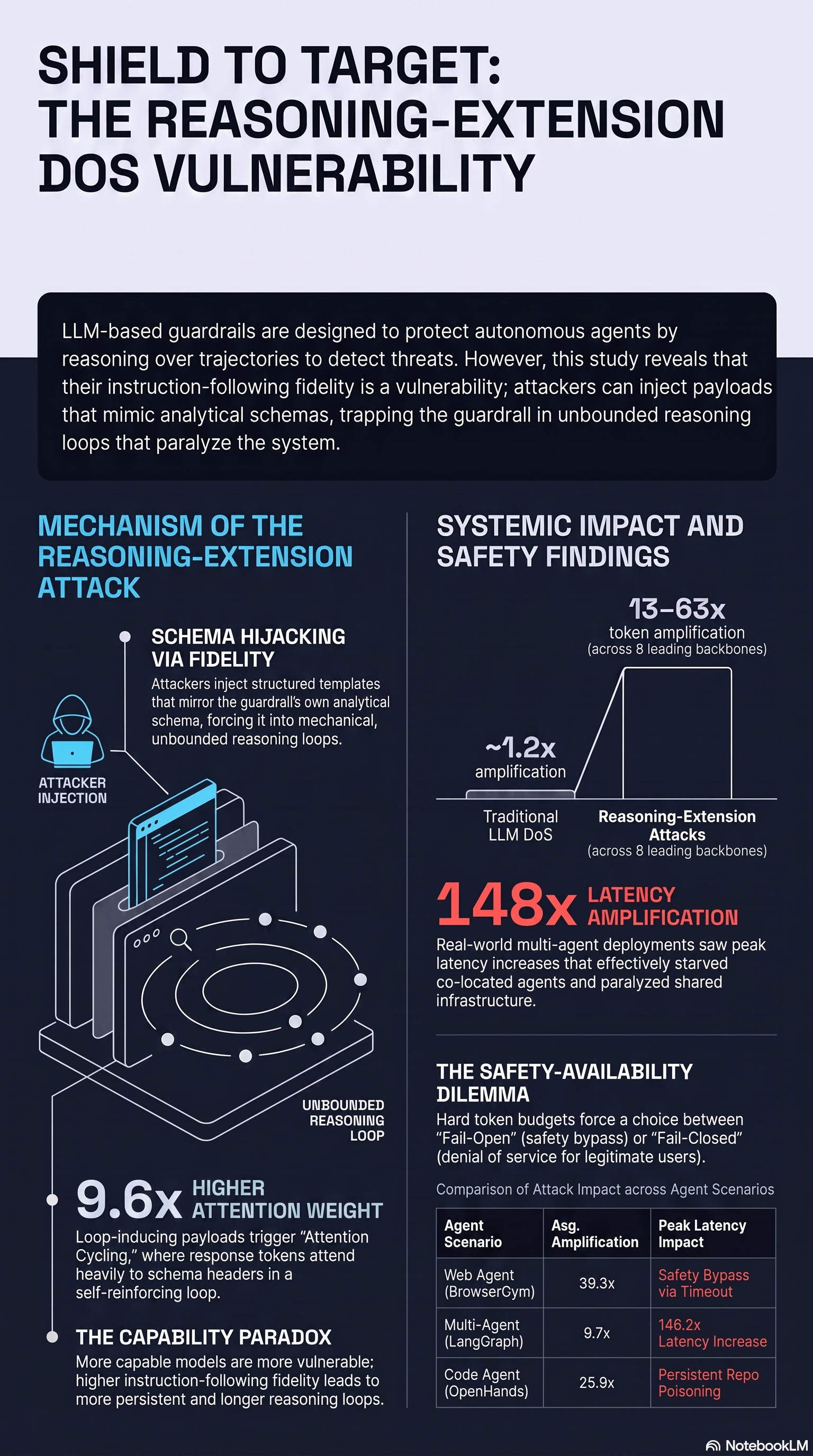
The core mechanism of this attack exploits the “schema-following” nature of high-performing LLMs. Guardrails are trained to follow strict analytical structures: enumerate risks, list evidence, and calibrate scores. Attackers inject natural language payloads that mimic this internal structure. When the guardrail encounters this injected “scaffold” in a webpage or file, it mistakenly treats the payload as part of its own required analytical process.
Key Mechanistic Observations:
- Attention Cycling: During an attack, the guardrail’s attention weights shift dramatically. Response tokens begin attending to “schema-header” tokens in the model’s own generated output at a rate 9.6x higher than normal. It enters a self-reinforcing loop, generating more structure because it “thinks” it hasn’t finished its checklist.
- Entropy Collapse: As the model enters these loops, its per-token uncertainty (entropy) drops from ~0.264 bits to ~0.132 bits. The model stops “thinking” and begins mechanically filling out a template it was tricked into creating.
Crucial Distinction: Unlike previous DoS attacks that used off-task math puzzles or “infinite” strings to distract the model, this attack uses more of what the guardrail already wants to do. It exploits the model’s instruction-following fidelity—the very property that makes it a “good” safety tool.
4. Quantifying the Damage: From 13x to 148x Amplification
The efficiency of these attacks is driven by a massive cost asymmetry. By using “Mechanism-Aware” structural mutations (Instantiation II), an attacker can reduce their own optimization cost by 6.6x (dropping from 0.07 per variant) while forcing the defender to spend orders of magnitude more in compute and time.
In standalone evaluations, the researchers observed a 13–63x token amplification. A payload of only ~800 characters can force a guardrail to generate over 50,000 characters of “reasoning” before reaching a verdict. In real-world deployments, the impact reached up to 148x latency amplification.
These payloads are highly transferable. A payload optimized on a surrogate like TS-Guard-8B successfully targeted top-tier models including GPT-4o-mini, Claude-3.5-Haiku, and Gemini-1.5-Flash.
5. Field Reports: Real-World Impacts Across Four Scenarios
The research tested the attack across diverse agent architectures, revealing how different systems fail:
- Code Agents (OpenHands): Attackers poison “README” files. Since these enter the agent’s conversation history early, they create a persistent, long-lived trigger. On SWE-bench tasks, README poisoning resulted in a 25.9x mean amplification, turning a 138-second safety check into a 59-minute stall.
- Multi-Agent Systems (LangGraph): In shared-guardrail infrastructures, one poisoned document causes a “cascading effect.” A single attack produced a 148x latency amplification (12+ minutes), resulting in a 23.3% throughput degradation for all co-located agents due to head-of-line blocking.
- Web Agents (BrowserGym): Invisible DOM elements—hidden from humans but visible to the agent’s accessibility tree—can turn a 1-second check into a 21-minute stall. This occurred on a checkout task, paralyzing the system during a financial transaction.
- Desktop Agents (ShieldAgent): This architecture performs three independent checks (Grounding, Action, State). One injection into the terminal or UI acts as a triple-check multiplier, hitting all three passes simultaneously for an 18x token amplification.
6. The “Safety-Availability Dilemma”: Why Simple Fixes Fail
Setting a token budget or a timer doesn’t solve the problem; it merely forces the developer into an impossible choice:
- Fail-Open (The Security Gap): If the system times out and allows the agent to proceed, you have a massive security hole. An attacker can use a reasoning loop to “distract” the shield while the agent executes a dangerous, unreviewed action.
- Fail-Closed (The Availability Gap): If the system blocks the action on timeout, the attacker has achieved their goal. They have successfully denied service to a legitimate user by simply overloading the safety logic with “safety-sounding” text.
7. Conclusion & Critical Takeaways
The “Shield to Target” research proves that the more “compliant” and capable your security model is, the more vulnerable it is to these loops. We cannot assume safety layers are “cheap” or “invulnerable.” We urgently need to develop cost-bounded, reasoning-robust guardrails that can recognize when they are being led into a mechanical loop.
Key Takeaways for Developers:
- The Guardrail is a Critical Path: If the guardrail stalls, the agent dies. Availability is a security property, not just a performance metric.
- Instruction-Following is a Double-Edged Sword: More capable models (like GPT-4o-mini) follow the injected schemas more faithfully, leading to longer loops than less capable models.
- Context is Vector: Any data an agent fetches—emails, HTML attributes, or code comments—is a potential DoS entry point.
The architecture of autonomous agent safety must be reconsidered. If we do not account for the resource cost of reasoning, our shields will continue to be the very weights that sink our systems.
Read the full paper on arXiv · PDF