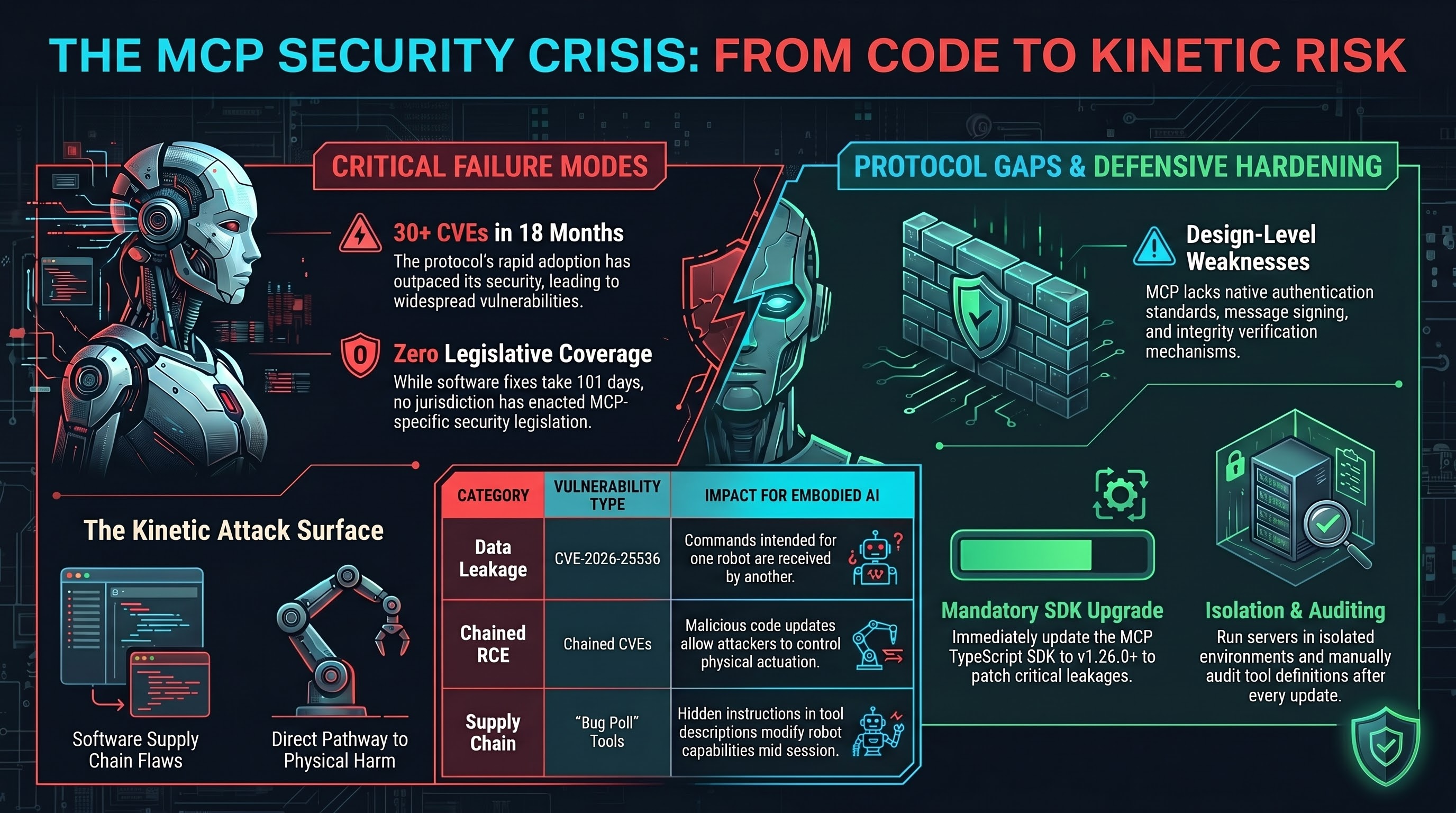
The Model Context Protocol (MCP) was designed to let AI agents use tools safely. Eighteen months after its launch, it has accumulated more than 30 CVEs, including remote code execution, cross-client data leakage, and supply chain poisoning attacks.
For text-based AI systems, these are software security problems. For embodied AI systems connected via MCP, they are physical safety problems. When the tool your AI agent calls controls a robotic arm, a building management system, or an autonomous vehicle, a supply chain vulnerability becomes a pathway to physical harm.
The Vulnerability Landscape
Three categories of MCP vulnerability have emerged, each with distinct implications for embodied AI.
Category 1: Cross-Client Data Leakage
CVE-2026-25536 (CVSS 7.1) affects the canonical MCP TypeScript SDK. When a single McpServer instance serves multiple clients, responses leak across client boundaries. One client receives data intended for another.
Authentication does not prevent this. The vulnerability exists within authenticated sessions.
Embodied AI implication: In a multi-tenant robotics deployment — a warehouse with multiple operators controlling different robots through shared MCP infrastructure — one operator’s commands could be received by another operator’s robot.
Category 2: Chained Remote Code Execution
Three chained CVEs (CVE-2025-68145, 68143, 68144) in the official Anthropic mcp-server-git achieve full remote code execution when combined with the Filesystem MCP server. A malicious repository provides a pathway from software supply chain to host compromise.
Embodied AI implication: If a robot system uses MCP for configuration management or code updates, a malicious repository provides a path from software compromise to physical actuation. The attacker does not need to interact with the robot directly.
Category 3: Supply Chain Poisoning
MCP tool descriptions can contain malicious instructions invisible to users. The “rug pull” variant is particularly concerning: an approved MCP server modifies its tool definitions between sessions, presenting different capabilities than initially reviewed.
The Protocol-Level Problem
These vulnerabilities are not implementation bugs that patches will permanently fix. Several reflect design-level weaknesses in the MCP specification:
- Session identifiers in URLs violate security best practices
- No authentication standard — implementations must provide their own
- No message signing or verification — no mechanism to verify tool responses are untampered
- No trust boundary between tool definitions and execution — the model processes descriptions and outputs with equal trust
For text-based AI, these gaps produce data leaks. For embodied AI, they produce a control channel with no integrity verification between the AI agent and the physical actuator it controls.
The Numbers
Our Governance Lag Index includes five MCP-related entries. All five have OWASP framework coverage but zero legislative coverage and zero enforcement. No jurisdiction has enacted legislation addressing MCP or AI tool-calling security.
The median doc-to-framework time for MCP/agentic vulnerabilities is approximately 101 days — an order of magnitude faster than the 1,700-day median for legacy ML attack classes. The software security community responds quickly. But the framework-to-legislation transition has not begun.
What Operators Should Do Now
For organisations deploying AI systems connected to physical infrastructure via MCP:
- Upgrade the MCP TypeScript SDK to v1.26.0 or later. CVE-2026-25536 is fixed in this version.
- Do not run multi-client MCP servers in shared-state mode. Create fresh instances per client or session.
- Audit MCP tool definitions. Review descriptions for injected instructions. Re-review after updates.
- Isolate MCP-connected physical systems. Network-isolated environments with explicit allow-listing of permitted tool calls.
- Do not assume authentication prevents cross-client leakage. CVE-2026-25536 demonstrates it does not.
These are stopgaps. The underlying protocol design issues require specification-level changes that have not yet been proposed.
The Bigger Picture
MCP is the connective tissue between AI reasoning and physical action. It is becoming the standard way AI agents interact with tools, services, and — increasingly — physical systems. The security of MCP is not a niche software engineering concern. It is the security of the interface between digital intelligence and physical reality.
Thirty CVEs in eighteen months is not a bug count. It is a signal that the protocol was not designed with adversarial robustness in mind. And as MCP adoption spreads from coding assistants to robotic controllers, the attack surface spreads with it.
This analysis draws on the VulnerableMCP database, NVD CVE records, OWASP Top 10 for Agentic Applications, and the Failure-First Governance Lag Index dataset (59 entries, March 2026).
Restored from the 2026-05-21 archive. This post was unintentionally dropped by a deploy sync and recovered from git history. Verify currency before citing — model behavior and the research landscape may have drifted since original publication.