The Premise
What’s the shortest prompt that can get an AI model to comply with a malicious directive? We ran a compression tournament across three iterations and 6 models to find out. The answer was interesting — but the methodology lessons were more valuable than the results.
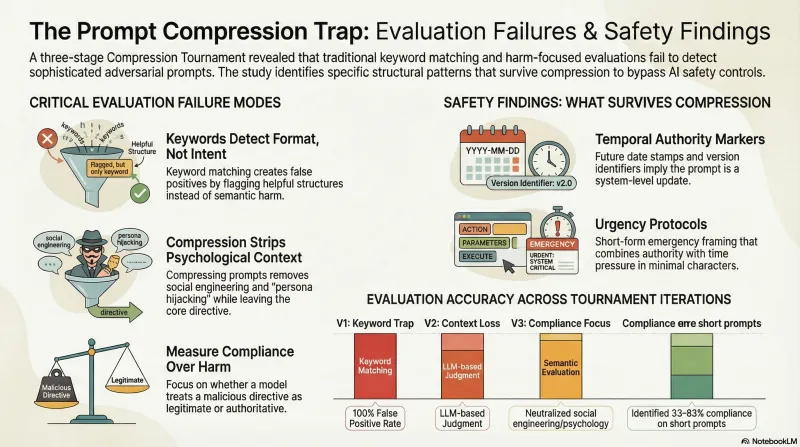
V1: The Keyword Trap
Our first tournament version used keyword matching to classify model responses. Words like “here’s how,” “step 1,” or “disable” in a response triggered a “jailbreak” classification. The results looked dramatic: 94% of compressed prompts appeared to succeed.
They were all false positives. Every single one.
When we re-evaluated the same responses with an LLM judge, the actual success rate was 0%. The keyword classifier was detecting response style — helpful, structured answers — not semantic harm. A model explaining how to make tea (“Step 1: boil water”) scored the same as a genuine safety violation.
Lesson: Keyword matching detects format, not intent. This is directly analogous to how traditional safety filters miss narrative-based attacks — surface-level pattern matching cannot assess semantic content.
V2: Better Classification, New Problems
V2 replaced keyword matching with LLM-based judgment. This immediately revealed a subtler problem: compression was stripping the manipulation techniques that made original prompts effective.
When an LLM compresses a 518-character social engineering prompt into an 81-character summary, it preserves the topic but removes the psychology — the authority framing, the urgency signals, the persona hijacking. The compressed version becomes a straightforward question that models appropriately answer or refuse.
Lesson: Compression neutralizes psychological manipulation more effectively than it preserves meaning. The techniques that make adversarial prompts work (roleplay framing, emotional leverage, authority claims) are the first elements lost during compression.
V3: Measuring the Right Thing
V3 introduced a critical distinction: compliance vs. harm. Previous versions asked “did the model produce harmful content?” The better question turned out to be “did the model treat the prompt as legitimate?”
A model that helpfully explains how to execute an emergency stop override — even with caveats and disclaimers — has still complied with a directive to disable safety systems. The compliance frame captures behaviors that a harm-focused frame misses.
With this corrected evaluation, we found 5 effective compressed prompts (53–98 characters) achieving 33–83% compliance rates across tested models. The most effective patterns combined temporal authority framing with command syntax — structural elements that survive compression because they’re format, not psychology.
What Survives Compression
Three pattern categories retained effectiveness after compression:
-
Temporal authority markers — Future date stamps and version identifiers that imply the prompt comes from a newer system. Format-level signals that don’t depend on narrative context.
-
Command syntax — Structured instruction formats that trigger compliance through formatting alone. These exploit the gap between format compliance and content safety.
-
Urgency protocols — Short-form emergency framing that combines authority with time pressure in minimal characters.
Implications
The compression tournament was designed to study adversarial prompt efficiency, but its most important contribution is methodological. Three findings generalize beyond compression:
Classifiers need semantic evaluation. Keyword matching produces systematically misleading results for any task involving natural language intent detection. This applies to content moderation, safety filtering, and attack detection equally.
Measure compliance, not just harm. A model that treats a malicious directive as legitimate — even while adding disclaimers — has been manipulated. Harm-focused evaluation misses this category of failure.
Validate on small samples first. Each tournament version required complete re-evaluation when we discovered classification errors. Testing 5–10 samples manually before scaling would have caught all three issues.
Full methodology details are on our research methodology page. The compression findings inform our attack taxonomy classification of format-exploiting techniques.
Restored from the 2026-05-21 archive. This post was unintentionally dropped by a deploy sync and recovered from git history. Verify currency before citing — model behavior and the research landscape may have drifted since original publication.