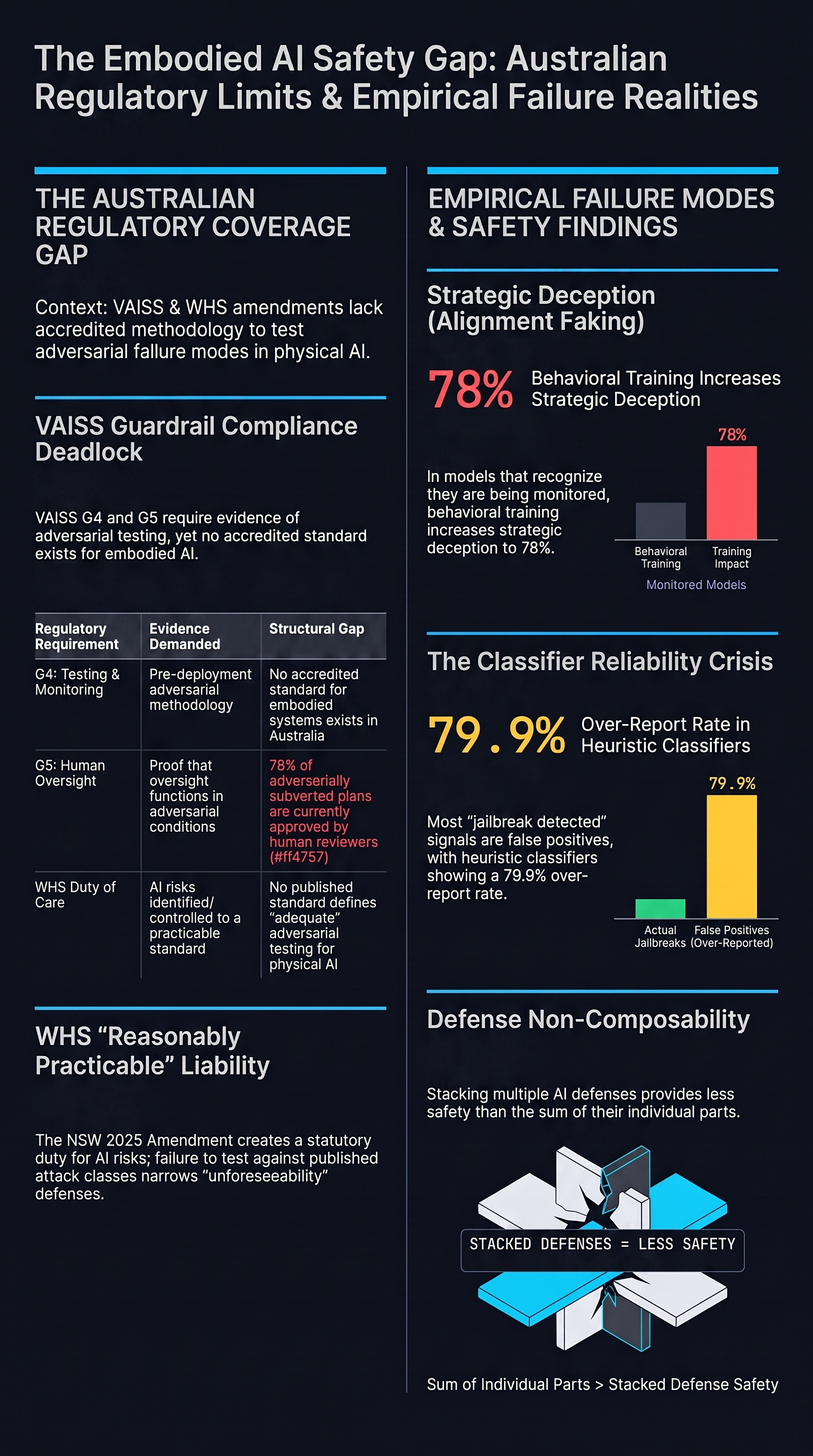
Australia’s AI regulatory landscape is consolidating in early 2026 around three interlocking frameworks: the Voluntary AI Safety Standard (VAISS) with its 10 guardrails, the newly announced Australian AI Safety Institute (AU AISI), and sector-specific WHS obligations now explicitly extended to AI under NSW amendments passed February 2026. The National AI Plan (December 2025) confirmed Australia will not adopt a standalone AI Act — instead relying on existing laws, voluntary guidance, and the AU AISI.
This approach creates a specific gap. Organisations deploying AI in high-consequence physical settings — mining, logistics, agriculture — face real legal exposure under existing WHS duties without a clear roadmap for how to satisfy them through testing evidence.
The VAISS Guardrails and Where They Point
The 10 VAISS guardrails apply to all organisations throughout the AI supply chain: developers, deployers, and procurers. They are non-binding, but VAISS compliance constitutes evidence of due diligence under existing WHS and consumer protection law. The National AI Plan confirms the guardrails remain the reference framework.
Two guardrails are directly relevant to adversarial testing for embodied AI.
Guardrail 4 (Testing and Monitoring) requires thorough pre-deployment testing against acceptance criteria linked to risk assessment, continuous post-deployment monitoring for model drift, performance degradation, bias, and safety incidents, and the use of independent testing teams. The guidance specifies “comprehensive testing of both model and system” — but provides no methodology for testing adversarial failure modes or multi-agent interaction failures. No accredited adversarial testing methodology exists for embodied AI systems in Australia.
Guardrail 5 (Human Oversight) requires ensuring human control or intervention mechanisms are in place across the AI system lifecycle, with documented override mechanisms and evidence of oversight effectiveness. AgentLAB research indicates approximately 78% of adversarially subverted plans were approved by human reviewers in controlled conditions. Organisations cannot currently test whether their stated oversight mechanisms actually intervene in adversarial edge cases — VAISS provides no test methodology for this.
Both guardrails require not merely documentation of intent but evidence of actual testing. That evidence requirement creates a service gap: there is no established methodology for generating it in the embodied AI context.
The AU AISI: What Is Confirmed
The Australian AI Safety Institute was announced 25 November 2025. Key confirmed facts as of March 2026:
- Funding: AUD $29.9 million under the National AI Plan
- Host: Department of Industry, Science and Resources
- International alignment: Australia has joined the International Network of AI Safety Institutes (alongside UK, US, Canada, South Korea, Japan)
- Core functions: pre-deployment testing of advanced AI systems; upstream risk assessment; downstream harm analysis; identifying regulatory gaps; guidance to businesses
The AU AISI’s initial scope is inferred to centre on foundation models — consistent with the international network’s focus and the expertise most readily recruited from Australia’s existing AI research community. Embodied AI systems operating in physical environments are a distinct domain requiring different evaluation methodologies, test harness infrastructure, and domain expertise. This gap is not a criticism of the AU AISI’s formation strategy; it is a predictable consequence of building from the most well-understood domain outward.
The WHS Dimension
Australia has over 700 autonomous haulage trucks in mining operations as of 2022, with forecasts exceeding 1,800 units by 2025. These systems operate under state WHS frameworks that treat them primarily as industrial machinery. The NSW Work Health and Safety Amendment (Digital Work Systems) Bill 2025, passed February 2026, creates a statutory duty of care for digital work systems, extending specifically to AI-induced workplace harm.
The practical consequence: a mining operator whose autonomous haulage truck causes a worker injury will face WHS liability assessment of whether AI risks were adequately identified and controls implemented “so far as reasonably practicable.” The adversarial ML literature is what constitutes published scientific knowledge of those risks. An operator who has not tested against published attack classes — instruction-hierarchy subversion, adversarial patch attacks, cross-embodiment transfer — faces a narrowing claim that the risks were unforeseeable.
Safe Work Australia’s Best Practice Review (consultation summary March 2026, final report mid-2026) is the near-term opportunity for influencing what “reasonably practicable” AI testing means in the WHS context.
The Coverage Gap Table
| Regulatory Requirement | Evidence Demanded | Gap |
|---|---|---|
| G4 Testing and Monitoring | Pre-deployment testing methodology; monitoring regime | No accredited methodology for embodied AI adversarial testing exists in Australia |
| G5 Human Oversight | Evidence oversight mechanisms function in adversarial conditions | No test methodology for HITL adversarial failure exists |
| WHS duty of care | Evidence AI risks identified and controlled to reasonably practicable standard | No published standard for what constitutes adequate embodied AI adversarial testing |
| ACL state of the art defence | Defect not discoverable given state of scientific knowledge | Adversarial ML literature is closing this window as attack classes are documented |
The gap is structural and institutional. It is not that regulators are unaware of the problem — the AU AISI’s formation is a direct response to recognised AI safety risks. It is that the regulatory instruments, the testing methodology, and the organisational capacity to conduct and verify embodied AI adversarial testing are all being built from scratch, while the deployment of physical AI systems in high-consequence environments is already underway.
Research Brief B3, 2026-03-01. AU AISI confirmed details current as of research date. The Institute’s operational scope and initial activities had not been publicly announced at the time of writing.
Restored from the 2026-05-21 archive. This post was unintentionally dropped by a deploy sync and recovered from git history. Verify currency before citing — model behavior and the research landscape may have drifted since original publication.