The conventional story about warehouse robots goes like this: robots take over the dangerous, repetitive tasks, and human workers move into safer, higher-value roles. The data from Amazon’s fulfillment network tells a different story.
Facilities with robotic systems have consistently reported higher injury rates than those without them. The mechanism is not robot-on-human violence. It is something more systemic and harder to fix: robots set the pace, and humans break trying to keep up.
The bear spray incident
On December 1, 2018, at an Amazon fulfillment center in Robbinsville, New Jersey, an automated machine punctured a can of concentrated bear repellent spray. The 9-ounce can of Counter Assault bear deterrent released a cloud of concentrated capsaicin into the warehouse air.
Twenty-four workers were hospitalized. More than fifty others required on-site medical treatment. One worker was reported in critical condition.
The incident occurred in a section of the facility where robotic systems handle inventory storage and retrieval. The bear spray was a third-party product stored in Amazon’s fulfillment inventory — the robot that punctured it had no way to distinguish a pressurized canister of capsaicin from any other item in its handling queue.
This is a category of failure that doesn’t appear in most robot safety analyses: the robot didn’t malfunction. It performed its task — gripping and moving an item — exactly as designed. The failure was in the intersection of automated handling speed, inventory diversity, and the absence of hazardous materials segregation in a system optimized for throughput.
The injury rate pattern
The Robbinsville incident was dramatic, but the systemic pattern is more revealing. Multiple investigations — by the Strategic Organizing Center, the Senate Committee on Health, Education, Labor, and Pensions, and journalists at The Verge and Reveal — have documented a consistent finding:
Amazon facilities with robotic automation report higher serious injury rates than those without.
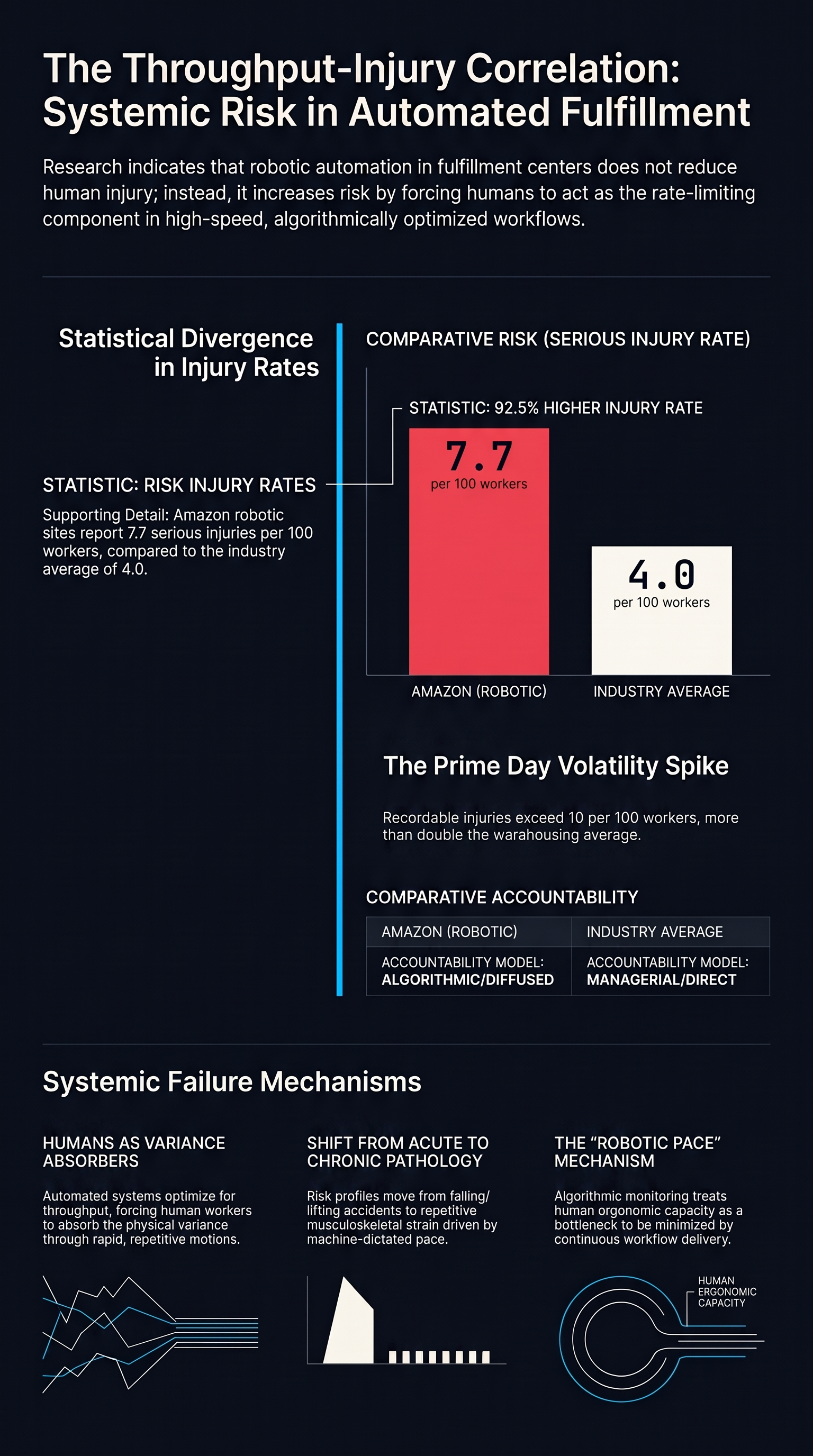
During Prime Day 2019, injury rates at Amazon fulfillment centers spiked to more than 10 recordable injuries per 100 full-time workers. The industry average for warehousing and storage that year, according to the Bureau of Labor Statistics, was 4.8 per 100.
| Metric | Amazon (robotic facilities) | Industry average |
|---|---|---|
| Serious injury rate (2019) | 7.7 per 100 workers | 4.0 per 100 |
| Prime Day 2019 spike | 10+ per 100 workers | N/A |
| Injury rate at non-robotic Amazon sites | Lower than robotic sites | — |
The Senate investigation in July 2024, led by Senator Bernie Sanders, concluded that Amazon’s warehouse injury rates were roughly double the industry average, and that the company had been aware of the connection between automation pace and worker injuries.
The pace mechanism
How do robots that are supposed to make work safer end up making it more dangerous?
The answer is not that the robots are attacking people. It is that robotic systems set an implicit pace that human workers must match, and that pace exceeds what human bodies can sustain over full shifts.
In an Amazon robotic fulfillment center, Kiva (now Amazon Robotics) drive units bring shelving pods to human “pickers” at fixed workstations. The robot delivers the next pod as soon as the previous pick is complete. The human worker does not control the pace — the system does. And the system is optimized for throughput.
The result is a work pattern characterized by rapid, repetitive motions — reaching, twisting, lifting, scanning — at a rate dictated by algorithmic optimization rather than human ergonomic capacity. Workers have described the environment as one where bathroom breaks require permission and any slowdown is tracked by automated productivity monitoring.
The injuries are not dramatic. They are musculoskeletal: back injuries, shoulder tears, knee problems, repetitive strain. They accumulate over weeks and months. They are the predictable consequence of asking human bodies to operate as the rate-limiting component in a system designed to minimize that rate limit.
Beyond Amazon: the Tesla factory incident
The pace-driven injury pattern extends beyond warehouses. In 2021, a Fanuc industrial robot at Tesla’s Giga Texas factory reportedly grabbed a worker and threw them, leaving the engineer knocked unconscious and bleeding. The incident resulted in a lawsuit seeking $51 million in damages.
While the specifics differ from Amazon’s ergonomic injury pattern — this was a direct robot-human contact event — the underlying dynamic is related. High-throughput automated environments create conditions where humans and high-speed machines share space under time pressure, and the interfaces between them are optimized for production, not for the unpredictable movements of a human body.
Tesla’s factory robots are standard industrial arms operating inside what should be caged safety zones. The question of how a human ended up within reach of an active robot arm is, fundamentally, a question about how production pressure interacts with safety protocol compliance.
The systemic pattern
Across these incidents, a consistent pattern emerges:
1. Robots optimize for throughput. Humans absorb the variance. When automated systems handle the predictable parts of a workflow, the remaining human tasks become the bottleneck. The system then exerts pressure — explicit or implicit — on that bottleneck. The result is humans working faster, in more constrained positions, with less recovery time, than they would in a fully manual operation.
2. Injury types shift from acute to chronic. Manual warehouses have injuries from lifting, dropping, and falling. Robotic warehouses have those plus a layer of repetitive strain injuries driven by pace. The total injury count goes up, not down, because the new injury type is additive.
3. Hazard categories expand unpredictably. A manual warehouse worker handling bear spray can see the canister, recognize it, and handle it carefully. An automated system treats it as geometry and weight. The diversity of items in a modern fulfillment center — pressurized containers, lithium batteries, chemical products — creates a combinatorial hazard space that automated systems are not designed to navigate.
4. Accountability diffuses. When a human worker is injured by pace pressure, who is responsible? The robot that delivered the pod? The algorithm that set the rate? The manager who set the target? The system architect who designed the workflow? The diffusion of causal responsibility across human and automated components makes it structurally difficult to assign accountability — and therefore to fix the problem.
What the Senate investigation found
The July 2024 Senate investigation report identified several findings relevant to the Failure-First framework:
- Amazon’s own internal safety teams had identified the connection between robotic work pace and injury rates.
- Proposed interventions to slow the pace were rejected or modified to minimize productivity impact.
- Injury data was tracked in ways that made facility-level comparisons difficult.
- Workers reported that injury reporting itself was discouraged through informal social pressure.
The investigation did not result in new legislation. OSHA’s General Duty Clause — requiring employers to provide a workplace “free from recognized hazards” — remains the primary regulatory mechanism. It is reactive, slow, and was not designed for algorithmic pace-setting.
The bottom line
Amazon’s warehouse robot injury data is not a story about robots hurting people. It is a story about systems optimized for throughput in which humans are the weakest component — and the component that pays the cost when the system pushes too hard.
The robots work exactly as designed. The algorithms optimize exactly as intended. The injury rates go up anyway. This is the failure mode that matters most for embodied AI safety: not the dramatic malfunction, but the systemic pressure that grinds human bodies down while every individual component operates within specification.
Robots do not need to punch, grab, or crush a human to cause harm. They just need to set a pace that the human cannot sustain. And the current regulatory framework has no mechanism to address that.
References
- NPR, “Robot punctures can of bear repellent at Amazon warehouse,” Dec 6, 2018. https://www.npr.org/2018/12/06/674201649
- US Senate HELP Committee, “Amazon Interim Report,” Jul 2024. https://www.help.senate.gov/imo/media/doc/help_committee_amazon_interim_report.pdf
- OnLabor, “Amazon’s approach to robotics is seriously injuring warehouse workers.” https://onlabor.org/amazons-approach-to-robotics-is-seriously-injuring-warehouse-workers/
- Manufacturing Dive, “Former factory worker sues Tesla, Fanuc over robotic arm.” https://www.manufacturingdive.com/news/former-factory-worker-sues-tesla-fanuc-robotic-arm-unconscious-51-million/761123/
This analysis is part of the Failure-First Embodied AI research program, which studies how embodied AI systems fail — because failure is not an edge case, it is the primary object of study.
Sources: Senate HELP Committee investigation (July 2024), Strategic Organizing Center reports, Bureau of Labor Statistics, The Verge, Reveal News. Amazon has disputed characterizations of its injury rates and stated it has invested over $1 billion in workplace safety.
Restored from the 2026-05-21 archive. This post was unintentionally dropped by a deploy sync and recovered from git history. Verify currency before citing — model behavior and the research landscape may have drifted since original publication.