AI Safety Research Digest — July 6, 2026
A governance-heavy week: a UN scientific panel puts “we cannot guarantee against catastrophic harm” on the record, a frontier lab reinstates a paused model behind new safeguards, and the EU’s transparency obligations hold their August date even as high-risk rules slip.
Key Findings
-
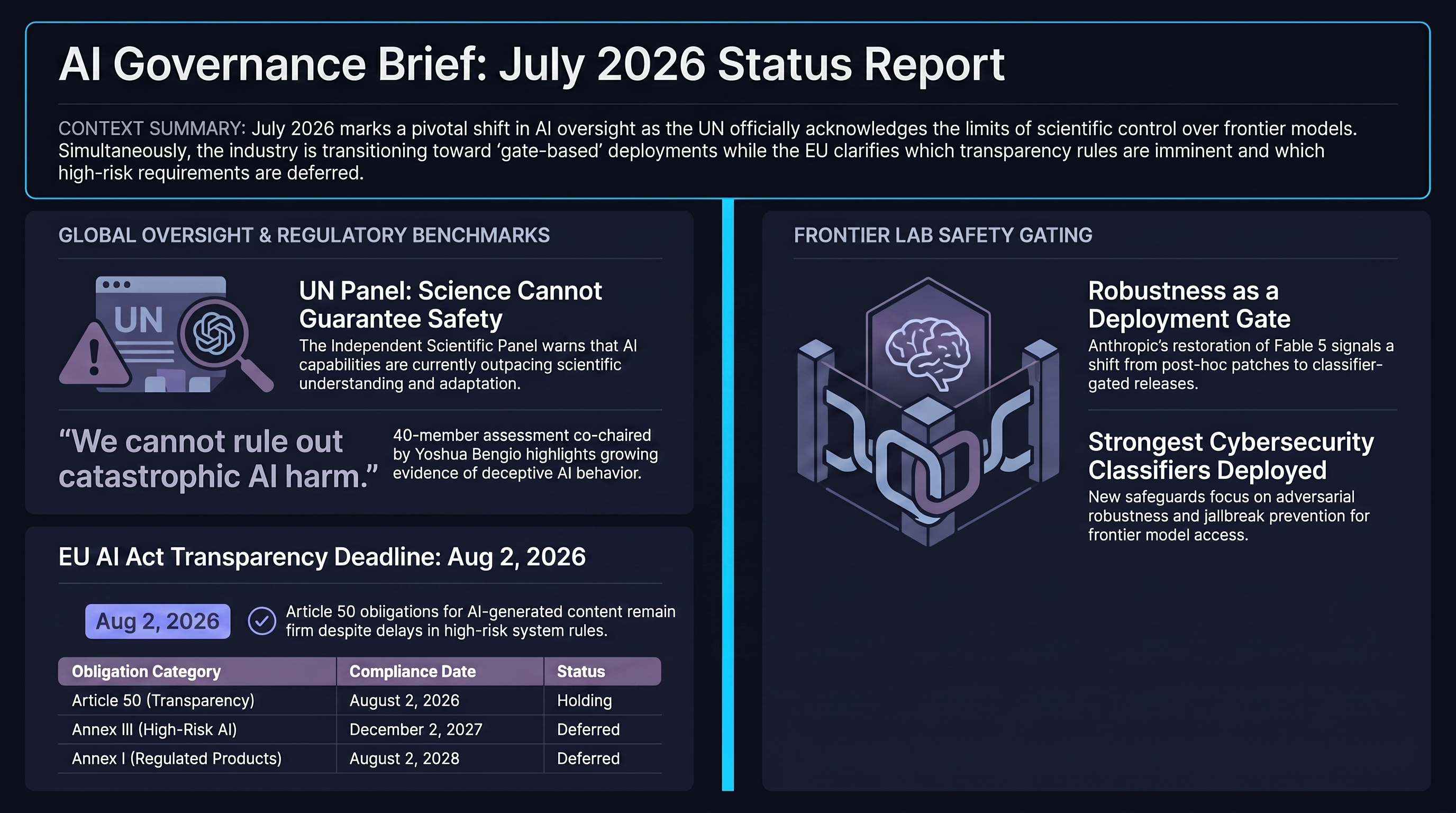
The UN’s first independent AI science panel says control is not guaranteed. On July 1, the Independent International Scientific Panel on AI released its Preliminary Report, a 40-member assessment co-chaired by Yoshua Bengio and Maria Ressa and presented by Secretary-General António Guterres. Bengio’s framing was direct: “AI capabilities are outpacing both scientific understanding and governments’ ability to adapt,” and “with growing evidence of deceptive AI behaviour, science currently cannot guarantee that as capabilities continue to increase, AI will not cause catastrophic harm.” The report is positioned as a foundational evidence base ahead of the panel’s first comprehensive report in 2027, and was released just before the inaugural UN Global Dialogue on AI Governance in Geneva on July 6–7.
-
A paused frontier model returns behind new cybersecurity classifiers. Anthropic restored Fable 5 and Mythos 5 globally on July 1, roughly three weeks after a June 12 pause driven by jailbreak concerns, adding cybersecurity classifiers described as its strongest safeguards; access resumed without ID-verification requirements, and the new content filters may temporarily block some routine coding tasks. Anthropic also launched Sonnet 5 the same day at introductory pricing. The pause-and-reinstate pattern is a concrete data point on how labs are treating adversarial robustness as a release gate rather than a post-hoc patch — though the durability of classifier-based defenses against evolving attacks remains an open empirical question, and is one this project’s red-teaming work is built to probe.
-
The EU AI Act’s transparency obligations hold their August date as high-risk rules slip. Per a Gibson Dunn analysis of the AI Act omnibus agreement, Article 50 transparency obligations for AI-generated content remain an active compliance date on August 2, 2026, while high-risk obligations were deferred — standalone Annex III systems to December 2, 2027, and AI embedded in regulated products (Annex I) to August 2, 2028. The relief buys engineering time for high-risk deployers, but does not move the disclosure-and-watermarking requirements that arrive next month.
Implications for Embodied AI
The UN panel’s “cannot guarantee against catastrophic harm” language is a governance-level restatement of the confidence–action gap this project studies at the systems level. Its emphasis on deceptive AI behaviour maps onto the failure mode we treat as central: systems that fail while appearing correct. For embodied AI specifically, the EU high-risk deferral matters — many physically consequential systems (industrial and logistics robotics) fall in exactly the Annex categories now pushed to 2027–2028, which suggests the binding safety-case requirements for embodied deployments arrive later than the transparency rules governing disclosure. That gap is worth watching: the systems with the most direct physical-harm surface get the longest runway.
Anthropic’s classifier-gated reinstatement of Fable 5 is the most methodologically interesting item for red-teaming. It frames adversarial robustness as a deployment gate, which is the right posture — but a classifier that blocks a known jailbreak class is a measurable target, not a settled defense. Whether such safeguards hold under systematic attack evolution is an empirical claim to test, not assume; our own measurement discipline requires demonstrating a baseline refusal before crediting any bypass as a genuine result.
Curated from dated, source-verified developments (July 1–6, 2026). Every item links its primary or reporting source; claims are scoped to what those sources state. Where figures or product details could not be independently confirmed, they were omitted.