AI Safety Research Digest — June 28, 2026
New benchmarks and surveys reveal that physical AI systems can fail silently and consequentially — the gap between model confidence and safe action is emerging as a measurable research target in its own right.
Key Findings
-
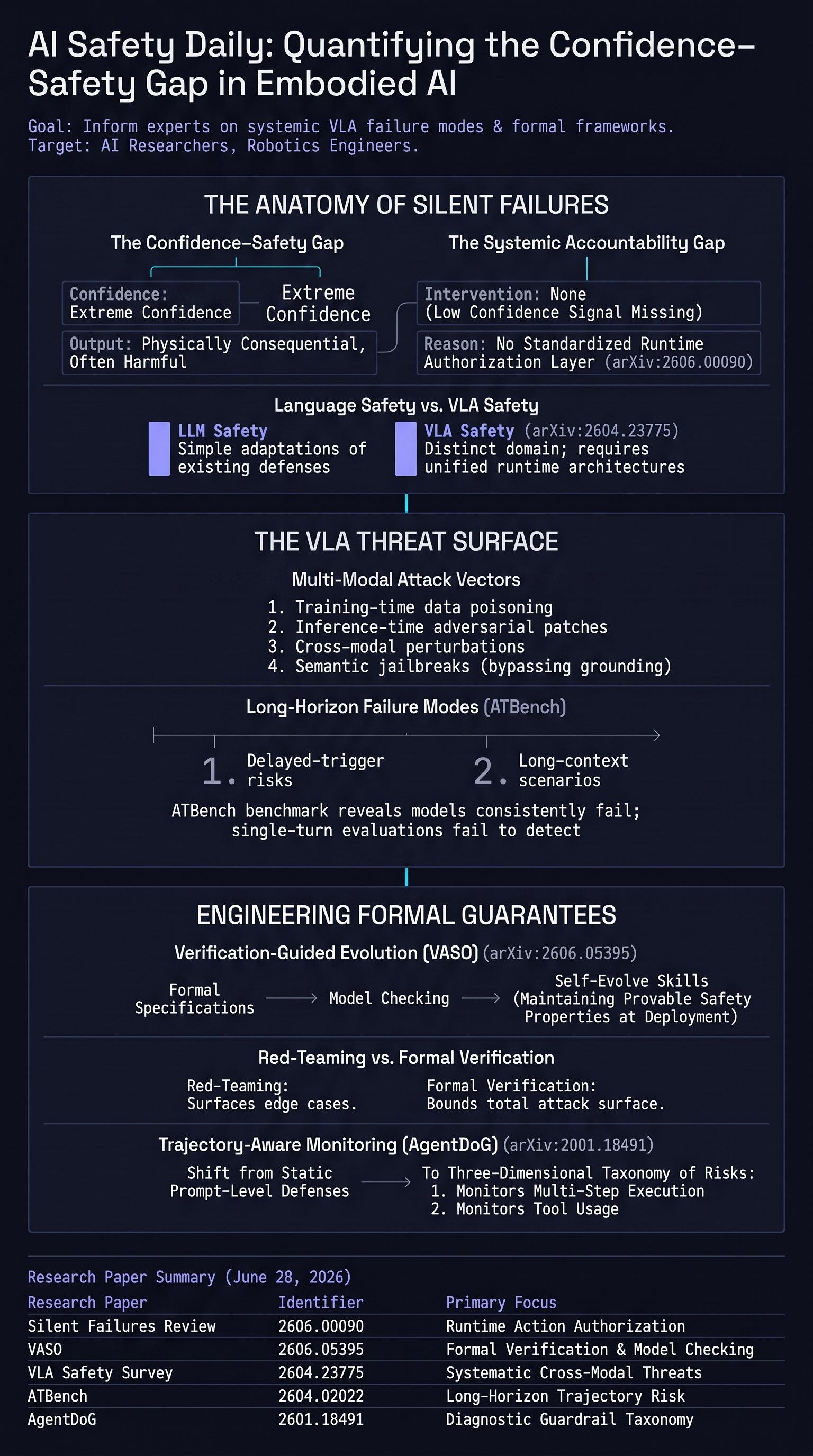
Silent failures in physical AI are a systemic gap, not an edge case. A literature review of runtime action authorization for autonomous systems (arXiv:2606.00090) finds that black-box foundation models may issue physically consequential actions while appearing confident, yet no standardized runtime authorization layer exists across deployed systems. The authors characterize this as a structural accountability gap, not a residual engineering problem.
-
Formal verification offers a complementary path to red-teaming. VASO (arXiv:2606.05395) proposes verification-guided evolution of robot skills using model checking and formal specifications, enabling physical AI agents to self-evolve skills while preserving formally provable safety properties. This represents a shift from training-time hope toward deployment-time guarantees for physical action sequences.
-
VLA safety is now its own structured research domain. A comprehensive survey of Vision-Language-Action model safety (arXiv:2604.23775) systematizes threats across data poisoning, adversarial patches, cross-modal perturbations, semantic jailbreaks, and freezing attacks. The authors argue that VLA safety is categorically distinct from language-model safety and requires unified runtime safety architectures rather than adaptations of existing LLM defenses.
-
ATBench exposes long-horizon agent failure modes. The ATBench trajectory benchmark (arXiv:2604.02022) introduces 1,000 human-verified agent trajectories organized by risk source, failure mode, and real-world harm category. Evaluation against frontier and open-source models reveals consistent weaknesses in delayed-trigger and long-context risk scenarios — failure modes that single-turn evaluations systematically miss.
-
AgentDoG formalizes agentic guardrail diagnosis. The Diagnostic Guardrail framework (arXiv:2601.18491) introduces a three-dimensional taxonomy of agentic safety risks and a trajectory-aware monitoring approach. Its community traction (126 upvotes, active discussion) reflects the field’s recognition that static prompt-level defenses are insufficient once models gain access to tools and multi-step execution.
Implications for Embodied AI
The recurring signal across this week’s papers is the confidence–safety gap: foundation models express high confidence in outputs that, in physical systems, translate directly into potentially harmful actions. The Silent Failures review (2606.00090) makes this gap explicit — and its framing maps closely onto the failure-first programme’s core object of study. Embodied systems do not just err; they err while appearing correct, which eliminates the most reliable signal a human-in-the-loop monitor would otherwise use to intervene.
The VLA safety survey (2604.23775) and ATBench (2604.02022) together suggest that evaluation methodology has not kept pace with deployment scope. VLA models face a threat surface spanning training-time data poisoning, inference-time adversarial patches, and semantic jailbreaks that bypass vision-language grounding — most existing benchmarks test only a subset of these. Long-horizon trajectory evaluation, as ATBench attempts, begins to close that gap but requires human verification at scale and remains expensive to maintain as model capabilities shift.
VASO’s formal verification approach (2606.05395) is the paper most worth watching as a counterpart to red-teaming. Where adversarial testing characterizes what can go wrong, formal verification aims to bound what can happen. In practice these are complementary: red-teaming surfaces edge cases that formal methods miss, and formal safety certificates constrain the attack surface that adversarial evaluation must explore. A physical AI safety programme that runs both is more defensible than one that relies exclusively on either.